Generation time by mode
Three distinct modes with very different cost profiles. Phase 2.5 (TTNN UNet +
cross-frame temporal attention) and its Lightning variant run at similar speed —
the bottleneck is the CPU temporal attention pass, not the denoising step count.
Phase 3 (full MotionAdapter) was ~8× slower because it round-tripped 7 injection
points through full AnimateDiffTransformer3D blocks on CPU at each step.
A batched D→H transfer optimisation (all N frames pulled in a single ttnn.concat → ttnn.to_torch)
cut Phase 3 to 52 s/frame — a 1.94× speedup. Skipping the two
costliest injection points (up1 + up2) cuts it further to 7.7 s/frame,
beating Phase 2.5 outright.
batched D→H transfer
PNDM 25-step
Measured timings
All runs on Blackhole P300C, warm model (TTNN JIT kernel already compiled). Times are wall-clock elapsed for 8 frames at 512×512.
| Mode | Scheduler | Steps | Frames | Total (s) | s / frame | n | Source |
|---|---|---|---|---|---|---|---|
| Phase 3 skip up1+up2 | PNDM | 25 | 8 | 62 | 7.7 | 1 | Benchmark 2026-06-15 |
| Phase 3 MotionAdapter · full · batched D→H | PNDM | 25 | 8 | 416 | ~52 | 1 | Benchmark 2026-06-15 |
| Phase 3 Lightning + MotionAdapter | Euler (trailing) | 8 | 8 | 405 | ~51 | 1 | Benchmark 2026-06-15 |
| Phase 3 MotionAdapter (baseline) | PNDM | 25 | 8 | 787–847 | ~101 | 6 | World's Fair run |
| Phase 2.5 cross-frame | PNDM | 25 | 8 | 95–104 | ~12.5 | 6 | Comparison study |
| Lightning cross-frame | Euler (trailing) | 8 | 8 | 95–97 | ~12.0 | 3 | Comparison study |
| Lightning cross-frame | Euler (trailing) | 8 | 8 | 103–104 | ~12.9 | 5 | Maya Q2, chip 3 (no stagger) |
| Phase 2.5 cross-frame | PNDM | 25 | 16 | 84–88 | ~5.4 | 3 | Comparison study (E) |
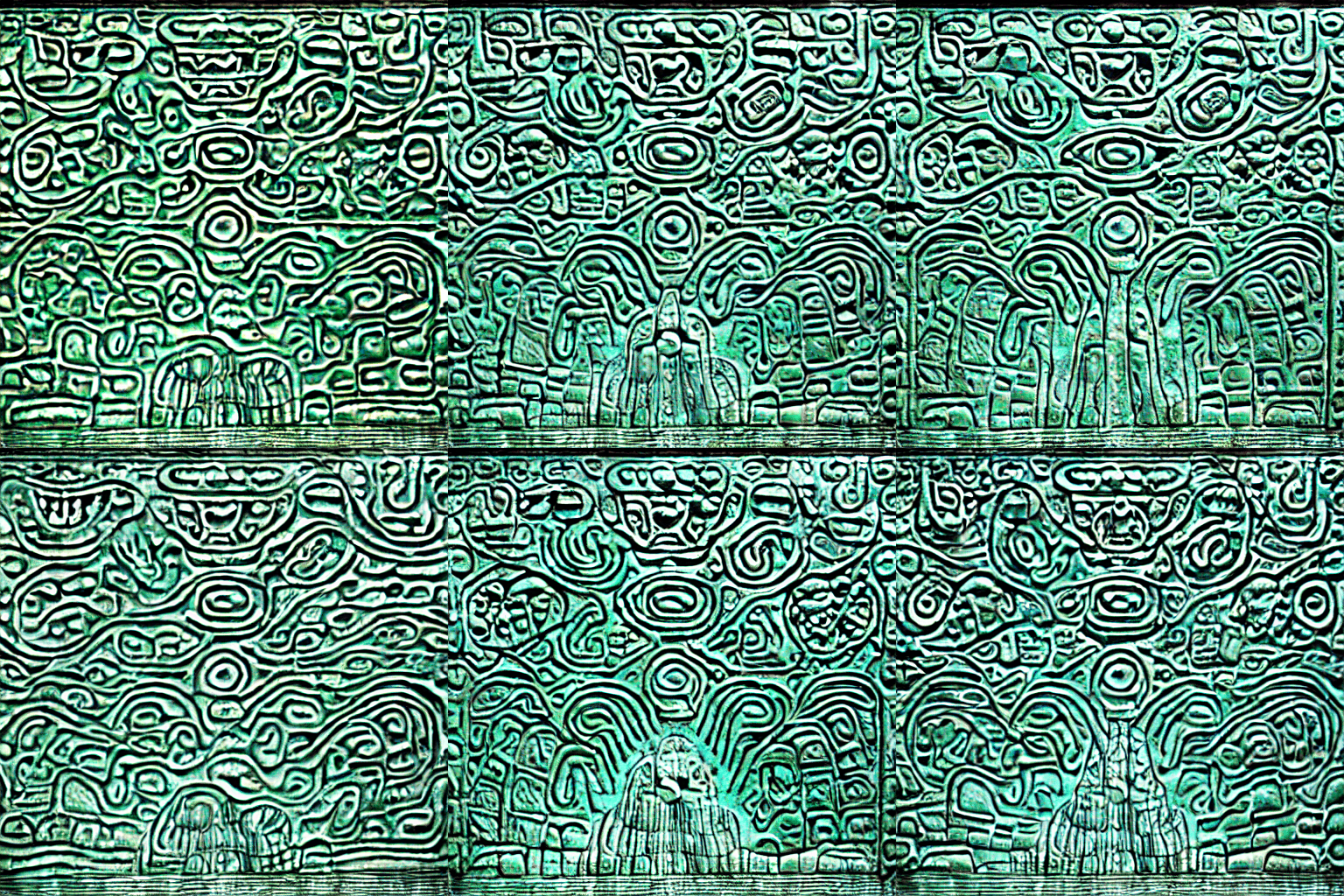
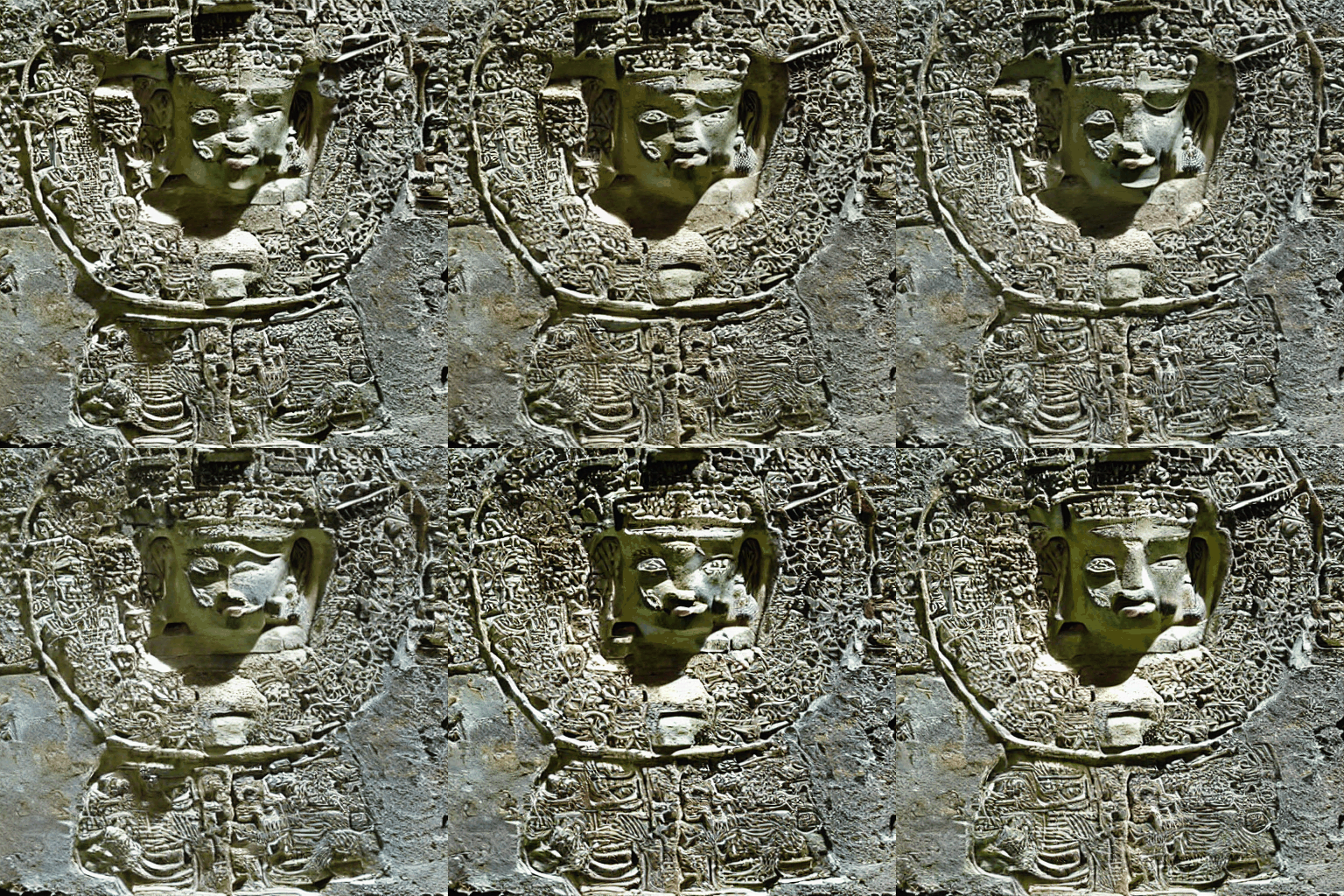
What does 6.75× faster look like?
Phase 3 skip (up1+up2) versus full Phase 3 — same prompt, same seed, same hardware. Skipping the two decoder injection points removes ~85% of the CPU transformer cost. The tradeoff: full Phase 3 has stronger overall temporal coherence across all 7 attention points; skip retains down-path and mid attention, which drives the main motion structure.


Execution flow
What runs on Blackhole silicon and what runs on CPU — including where Lightning diverges from standard PNDM, and where Phase 3 adds the full MotionAdapter CPU round-trip.
The TTNN UNet runs on Blackhole; everything else (CLIP, schedulers, cross-frame blend,
VAE decode) is CPU. Lightning on Blackhole switches to
EulerDiscreteScheduler (trailing timesteps, linear β) with the base TTNN
UNet — it does not load ByteDance's distilled adapter (which is CPU-only and
bakes CFG=1.0). CFG stays at 7.5. On CPU, --lightning loads the genuine
distilled adapter and requires exactly 2/4/8 steps.
Phase 3 inserts a full AnimateDiffTransformer3D CPU
round-trip at 7 UNet injection points per denoising step — that's what makes it
~8× slower than Phase 2.5.
Skipping up1 (32×32, C=1280) and up2 (64×64, C=640) removes the two costliest injection points, which together account for ~80% of Phase 3 CPU overhead. The five remaining points (down0/1/2, mid, up0) operate at smaller spatial dimensions and complete quickly. Result: 7.7 s/frame — faster than Phase 2.5 — with weaker decoder-side temporal coherence as the tradeoff.
What the numbers tell us
Bottleneck: CPU temporal blend, not TTNN
The TTNN UNet processes one frame per call in ~0.5s (warm). At 8 frames × 25 steps that's 100 UNet calls × 0.5s = 50s of silicon time. The remaining ~50s is CPU overhead: cross-frame attention, scheduler steps, and data marshalling. Reducing steps to 8 cuts UNet time to 16 calls × 1.3s ≈ 20s but CPU overhead stays — hence the flat total.
Lightning per-step is slower than PNDM
Each PNDM UNet call takes ~0.5s; each Euler (Lightning) call takes ~1.3s. The Euler scheduler with trailing timesteps and linear β uses different noise magnitudes that require heavier L1 operations inside the TTNN UNet. Fewer steps compensate — the two modes end up at near-identical wall clock.
16 frames is more efficient than 8
8 frames at 25 steps: ~12.5 s/frame. 16 frames at 25 steps: ~5.4 s/frame — a 2.3× per-frame improvement. The TTNN UNet pipeline amortizes its initialization cost better, and the cross-frame attention benefits from the larger batch. Generate longer clips when possible.
Phase 3 cost is injection-point overhead
Phase 3 runs AnimateDiffTransformer3D.forward() at 7 UNet injection
points per denoising step. At 25 steps that's 175 full transformer forward passes on
CPU. The two decoder points up1 (32×32, C=1280) and up2 (64×64, C=640) account for
~80% of that cost — skipping just those two drops from 52 s/frame to 7.7 s/frame,
faster than Phase 2.5. Tradeoff: weaker decoder-side temporal coherence.
Lightning doesn't help Phase 3
Tried 8-step Euler + MotionAdapter: 404s, 50.6 s/frame — nearly identical to
25-step PNDM at 416s. With 7 CPU bridge calls per denoising step, cutting steps
25→8 saves TTNN time (~15s) but barely dents the total. The bottleneck is the
CPU AnimateDiffTransformer3D at each step, not the denoiser count.
Injection-point skipping is the only lever that moves the needle.
4-chip parallel throughput
The TTNN SD 1.4 UNet uses to_torch() internally without a mesh composer,
so it cannot shard across chips in a single process. Parallelism is achieved by running
4 separate generate.py processes each pinned to --device-id 0–3.
The Maya benchmark generated 20 glyphs across 2 tiers (40 total) in ~5 batches of 4,
each batch taking ~105s.
Lightning quality on Blackhole
Because the distilled ByteDance adapter is not loaded on Blackhole, Lightning mode here is not the same as CPU Lightning. It uses the base SD 1.4 UNet with an aggressive Euler schedule — quality is comparable to PNDM 8-step with the same model, not to fully distilled 8-step inference. CFG=7.5 is retained, which distilled Lightning would bake to 1.0.
¹ All timings are wall-clock elapsed for warm runs (TTNN JIT kernel already compiled from a previous run in the same process chain). Cold-start (first run) includes a 60–90s compilation overhead.
² All 2026-06-15 benchmark runs: 8 frames, 512×512, warm model, prompt "a majestic waterfall in a lush rainforest, cinematic lighting". Phase 3 full (416s, 25 PNDM steps, batched D→H); Phase 3 skip up1+up2 (62s, 25 PNDM steps, 5 injection points); Lightning + MotionAdapter (404s, 8 Euler steps, all 7 points). Phase 3 baseline (787–847s) from World's Fair run (6 scenes). Phase 2.5 / Lightning timings from comparison study (3 prompts) and Maya Tzolk'in Q2 (chip 3, 5 batches).
³ "Lightning" on Blackhole/sim = EulerDiscreteScheduler (trailing, linear β) + base SD 1.4 TTNN UNet. Not the ByteDance distilled adapter — that requires CPU mode with --mode cpu --lightning --lightning-steps 4.
⁴ Hardware: Tenstorrent QB2 board, 4 × P300C Blackhole chips, measured June 2026.