Mailboxes
SEP host mailbox architecture and interrupt routing shows the host mailbox connections and interrupt routing.
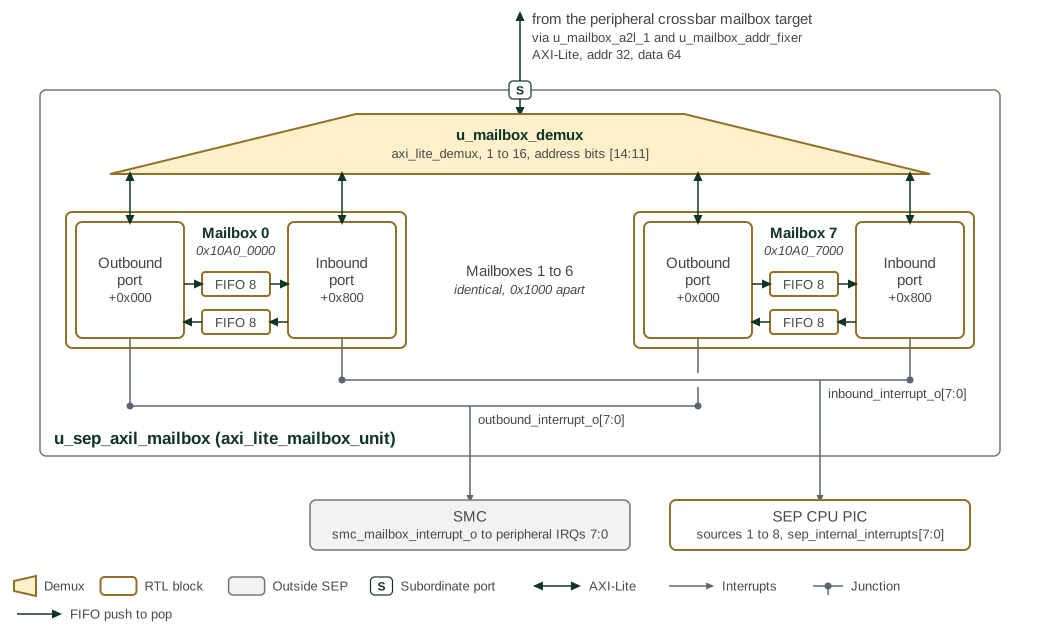
The mailbox unit takes one AXI-Lite port from the peripheral crossbar, and its
demux selects one of sixteen 2 kB port apertures from address bits 14 to 11.
Mailbox m occupies the 4 kB at 0x10A0_0000 + m × 0x1000, with its
outbound port at offset 0x000 and its inbound port at offset 0x800. The
figure draws mailboxes 0 and 7; mailboxes 1 to 6 are identical. Each mailbox
holds two FIFOs of eight 64-bit entries, and WRITE_DATA in one port pushes the
FIFO that READ_DATA in the other port pops. Every port has its own
level-sensitive, active-high interrupt. The eight inbound-port interrupts are
SEP CPU PIC sources 1 to 8. The eight outbound-port interrupts leave SEP on
smc_mailbox_interrupt_o and reach the SMC as its peripheral interrupts 7 to 0.
SEP uses mailboxes to exchange service requests with system clients, such as software running on application-processor (AP) cores. A client is the requester whose communication context software wants to keep separate; it need not be an entire processor. The system’s firmware policy assigns mailbox apertures to clients and configures the inbound traffic filter to control their access. The hardware does not establish a fixed one-client-per-core allocation.
Each mailbox occupies a 4 KiB aperture and has an inbox/outbox pair. Its privacy depends on the programmed access policy, not on a distinct hardware mailbox type. When the inbox is written, an interrupt is sent to the SEP CPU to notify it of an incoming service request. Similarly, when the outbox is written by the SEP, an interrupt is sent to the SMC. The outbox is only used for communication with AP cores. For all other resources we only use inboxes on both ends of the transaction.
The SEP mailboxes have 64-bit data registers while SEP is a 32-bit system. Registers sit on an 8-byte stride and are decoded by which 8-byte slot the address falls in, so a register’s low and high halves alias to the same register. The SEP CPU is RV32 and can reach only one half per instruction, which makes every half-word access a full-register access at the mailbox:
-
A read of
READ_DATAat either half pops one FIFO entry. The mailbox drives the whole entry; the CPU keeps the half selected by address bit 2 and discards the other. Reading both halves consumes two entries. -
A write of
WRITE_DATAat either half pushes one entry, with bytes outside the write strobe pushed as zero. A 32-bit store to the low half enqueues{32’h0, data}.
SEP can use either half, but never both halves of one entry, so a SEP-visible payload is 32 bits per entry and both ends must agree on which half carries it. SEP firmware uses the low half at the register base offset.
This depends on the mailbox aperture staying side-effect in mrac.
Clearing side-effect enables the core’s load-to-load forwarding and
speculative accesses, both of which pop entries unpredictably. The
Programmer’s Guide lists it among the
mailbox usage rules.
|
Mailbox type is a configuration, not a hardware variant. Every mailbox is an identical instance of the same block; what makes one an ISS mailbox and another an STEE or Regular mailbox is the inbound traffic filter entry that covers its 4 kB aperture. The filter blocks by default, so a mailbox with no enabled entry over its aperture is unreachable from the fabric, and reprogramming an entry retypes that mailbox at run time. An entry pairs an address range with the qualification criteria below, plus separate read and write permissions and a write-once lock bit. See Filtering and Protection for the SEP filter instances and AXI Traffic Filter for the entry registers and the decode algorithm used to program them.
SEP mailbox qualification describes the traffic qualifications used to distinguish mailbox types.
| Mailbox Type | Description |
|---|---|
ISS |
Uses fabric source ID to qualify incoming transactions. Legal source ID is programmable, lockable and reset by SEP reset. |
STEE |
Relies on STEE indicator in the transactions (NS bit) to qualify incoming transactions. |
DTEE |
Reserved. Would rely on the DTEE indicator in the transactions (confidential bit) to qualify incoming transactions. TODO: Confidential bit will be defined in future revisions, right now there is no hardware to qualify this. |
Regular |
Relies on PMA/PMP or page table for protection. No special action required by SEP. |