Trap Handler
Implements exception and interrupt handling for the test framework. Provides default handlers that fail tests on unexpected exceptions/interrupts. Supports exception validation by allowing tests to configure expected trap codes and return addresses.
Architecture
The trap handling system uses multiple entry points managed from Machine mode:
- Machine Mode Trap Handler
Entry at
mtvecHandles all syscalls (ecalls) from any privilege mode
Handles non-delegated exceptions and interrupts
- Supervisor Mode Trap Handler (non-virtualized)
Entry at
stvecHandles exceptions delegated via
medeleg
- HS-mode and VS-mode Trap Handlers (when
test_envis virtualized) HS-mode handler at
stvechandles exceptions delegated viamedelegVS-mode handler at
vstvechandles exceptions delegated viahedeleg
Delegation registers (medeleg/mideleg/hedeleg/hideleg) control
how non-ecall traps get delegated. By default, these are set randomly.
Interrupts
By default nested interrupts are not supported. Interrupts are cleared and then return to code. To override an interrupt handler, a test can register a custom interrupt handler with ;#vectored_interrupt - Configure Interrupt Handlers.
Exceptions
Exceptions return to the Runtime Environment and run the exception handler.
Expeceted exceptions can be configured using OS_SETUP_CHECK_EXCP macro.
This informs the exception handler what the exception PC and cause are, and where to return after an exception.
This is useful for testing expected exceptions.
Unexpected exceptions will cause the test to fail, unless FeatMgr.skip_instruction_for_unexpected is set.
Hart Context
The Hart Context is managed through the Variables module.
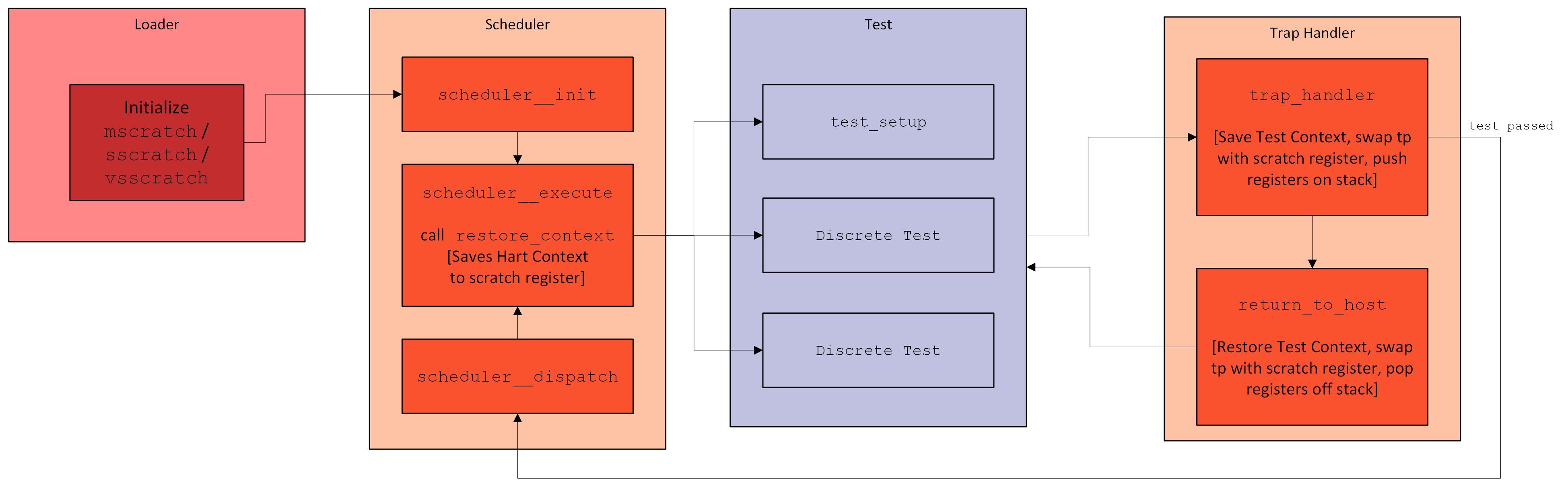
A the start of a trap, the Test’s context is swapped with the Hart Context.
This is done by swapping the scratch register with tp, swapping the sp register with the Hart Context’s sp variable, and pushing temporary registers to the stack.
If the test needs to return control to the Test Environment, the Hart Context is swapped back when the trap is exited.
Configuration
cfiles: Enable context saving/restoring for C file integrationmedeleg/mideleg: Control which exceptions are delegated to S-mode handlersskip_instruction_for_unexpected: Skip an instruction for unexpected exceptions
Note
The deleg_excp_to option is a convenience that sets delegation registers
so that all non-ecall exceptions are delegated to the specified mode.
By default, delegation registers are set randomly.