A curated directory of projects, tools, models, and research for Tenstorrent hardware — contributed by the community and our team. Browse by category or search across all entries.
171Projects
13Categories
Browse by category
🚀 Getting Started
The essential first steps — installer, core SDKs, and guided onboarding
tt-vscode-toolkit
official
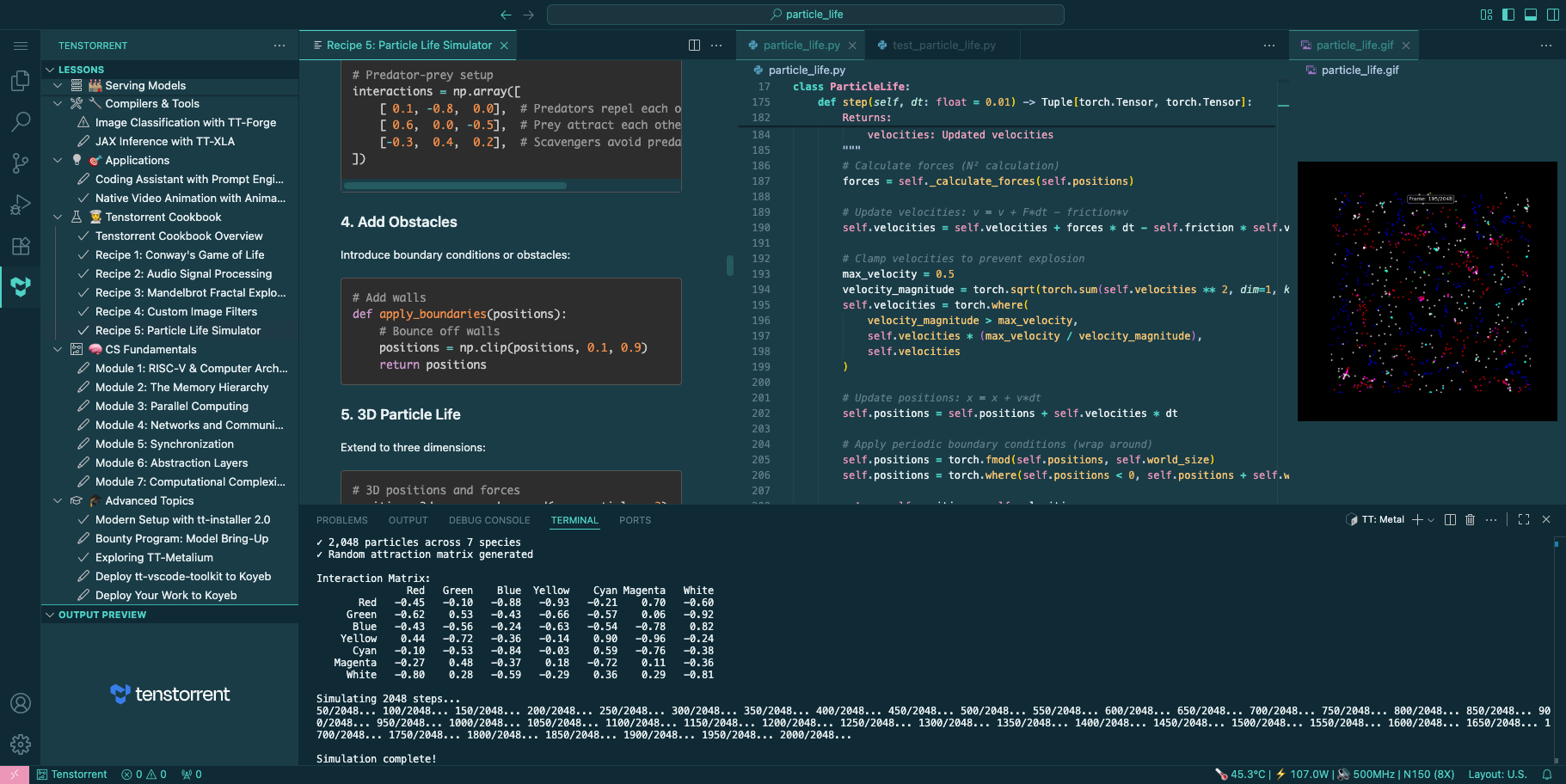
48 interactive lessons covering the full Tenstorrent developer path — from hardware detection to cus…
tt-sim Lab
affiliated
A university teaching lab for TT-Metalium kernel programming on a virtual Tenstorrent chip — one-cli…
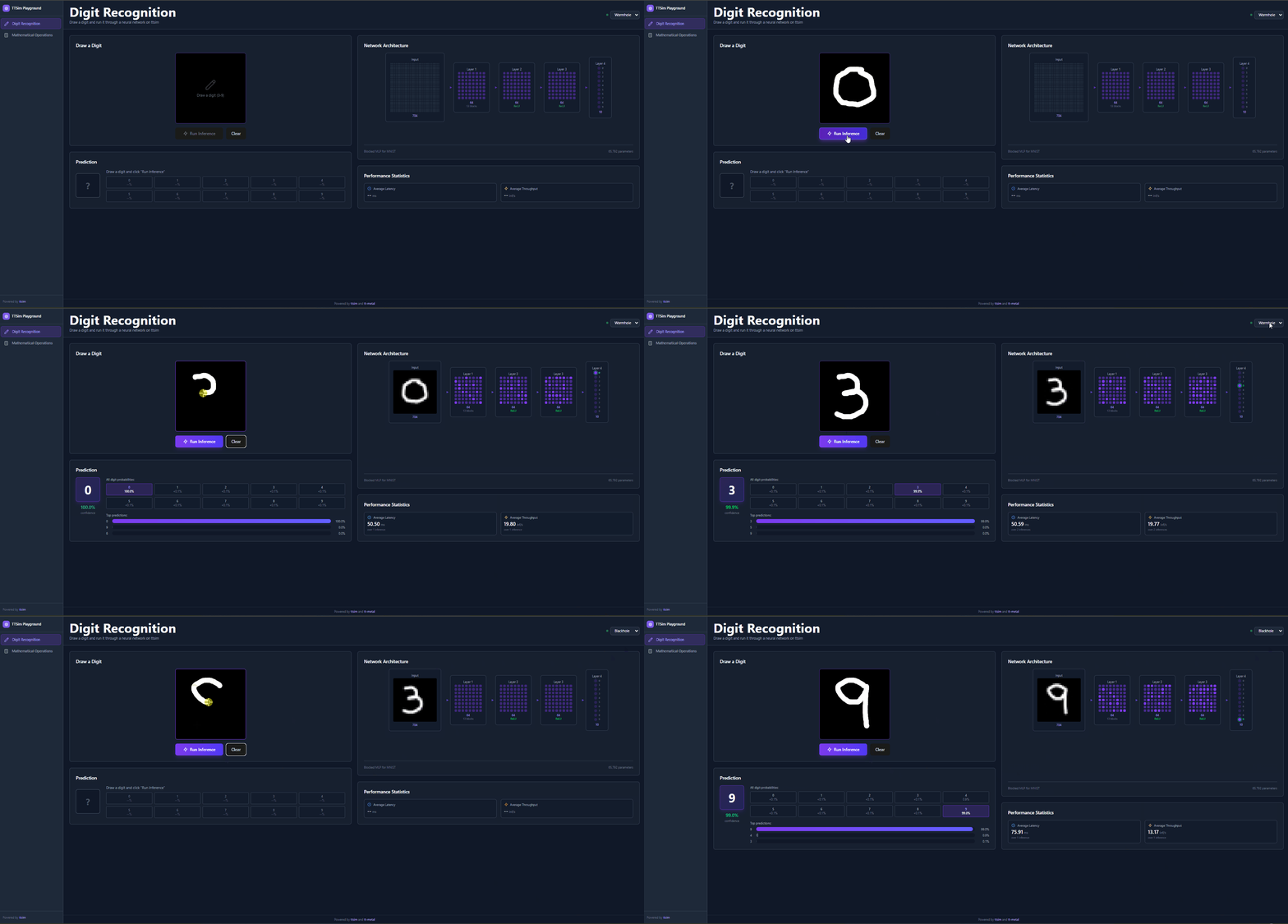
Tenstorrent Simulator Playground
community
A web playground that runs real TTNN operations on the ttsim hardware simulator — no card required. …
🤖 AI & Models
Running, serving, and experimenting with AI models
tt-lab
official
A whole LLM inference stack you can read end to end: gpt-oss-20b and gpt-oss-120b running on Blackho…
tt-bio
affiliated
Boltz-2 biomolecular model for drug discovery on Tenstorrent Blackhole. Supports single-card and mul…
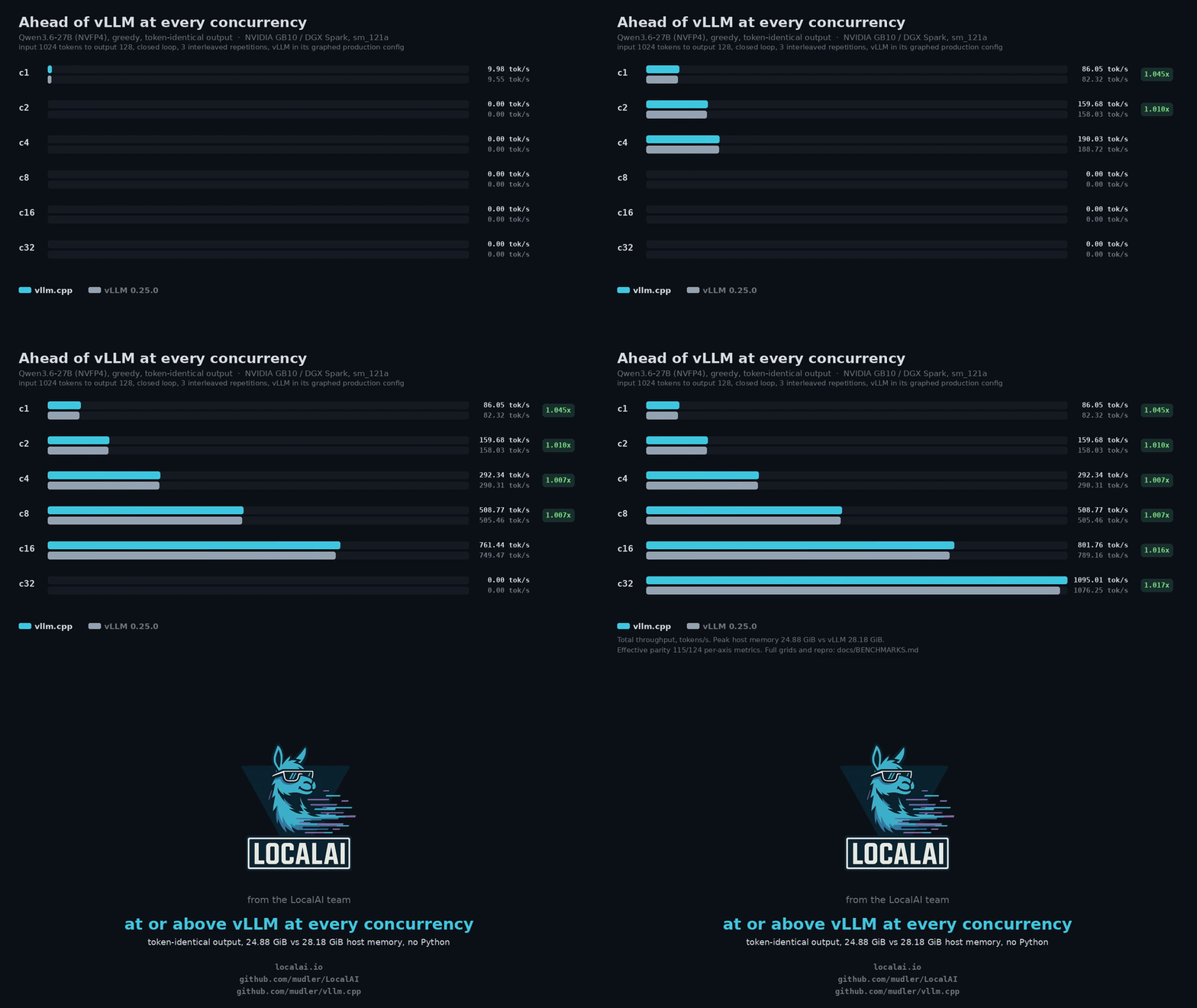
vllm.cpp
community
A C++ reimplementation of the vLLM engine (continuous batching, paged KV cache, GGUF loading) with C…
🕵️ AI Agents
Agentic systems and AI assistants running on TT hardware
Tenstorrent Skills
official
Official agent-skill marketplace for Claude Code and Codex, aimed at tt-metal, TTNN, Metalium, and m…
Local AI Agents on Tenstorrent
affiliated
Three agentic projects running fully on-device: local AI agents on QuietBox 2, a coding assistant po…
dstack
community
Vendor-agnostic orchestration for training, inference, and agentic workloads across NVIDIA, AMD, TPU…
Tenstorrent's MLIR-based compiler frontend. Enables running AI workloads from PyTorch, ONNX, and oth…
tt-forge-compiletron
affiliated
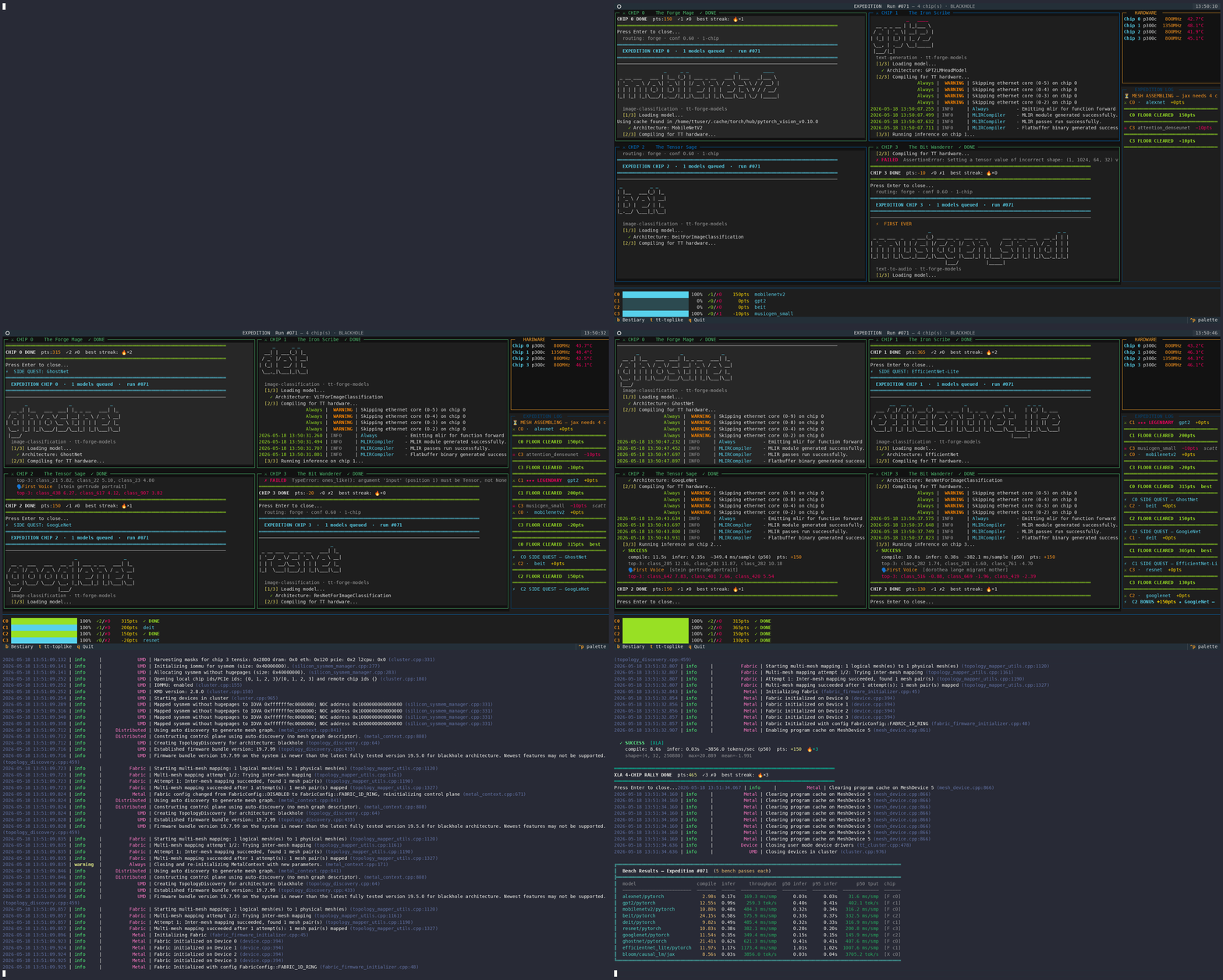
Compile more than 100 models on tt-forge in a display format suitable for demos. Comprehensive showc…
Booth
community
An open-source CUDA, HIP, and Triton compiler with no LLVM anywhere in the path. Takes the same sour…
🛠 Dev Tools & Debugging
Profiling, visualization, and debugging workloads
ttsim
official
Fast full-system simulator of Tenstorrent Wormhole and Blackhole hardware. Runs TT-Metalium workload…
tensix-viz
affiliated
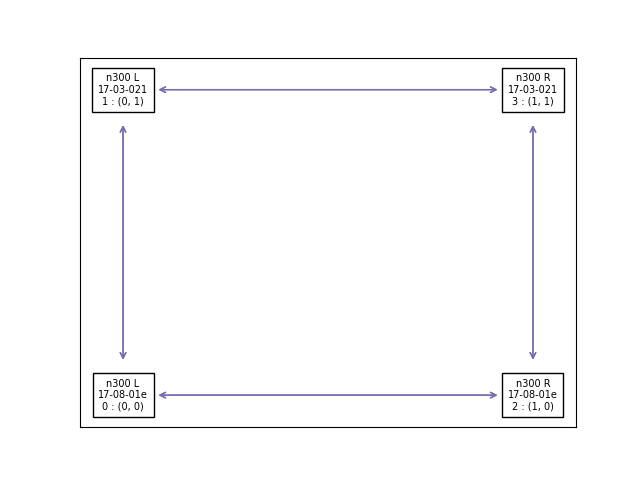
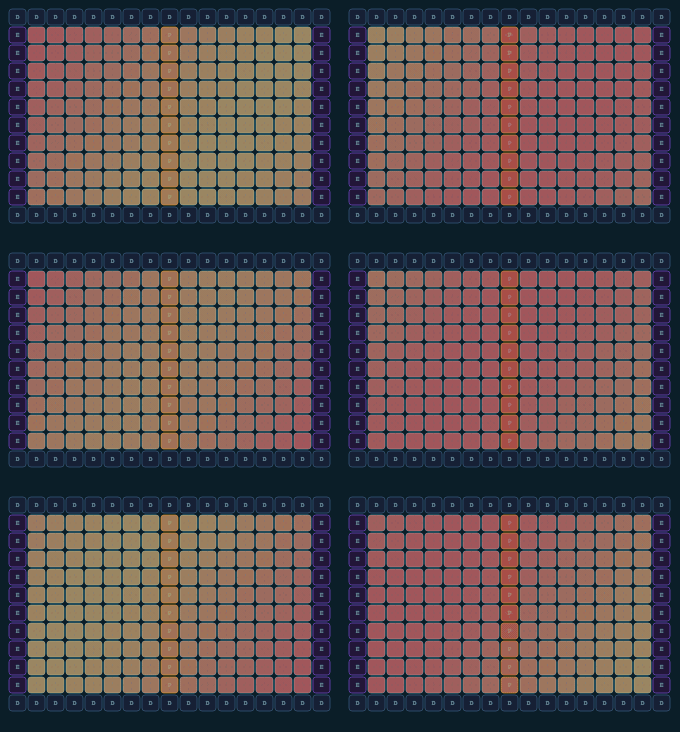
Hardware topology visualizer for Tenstorrent chips — from individual chip to full cluster. Interacti…
nvtop
community
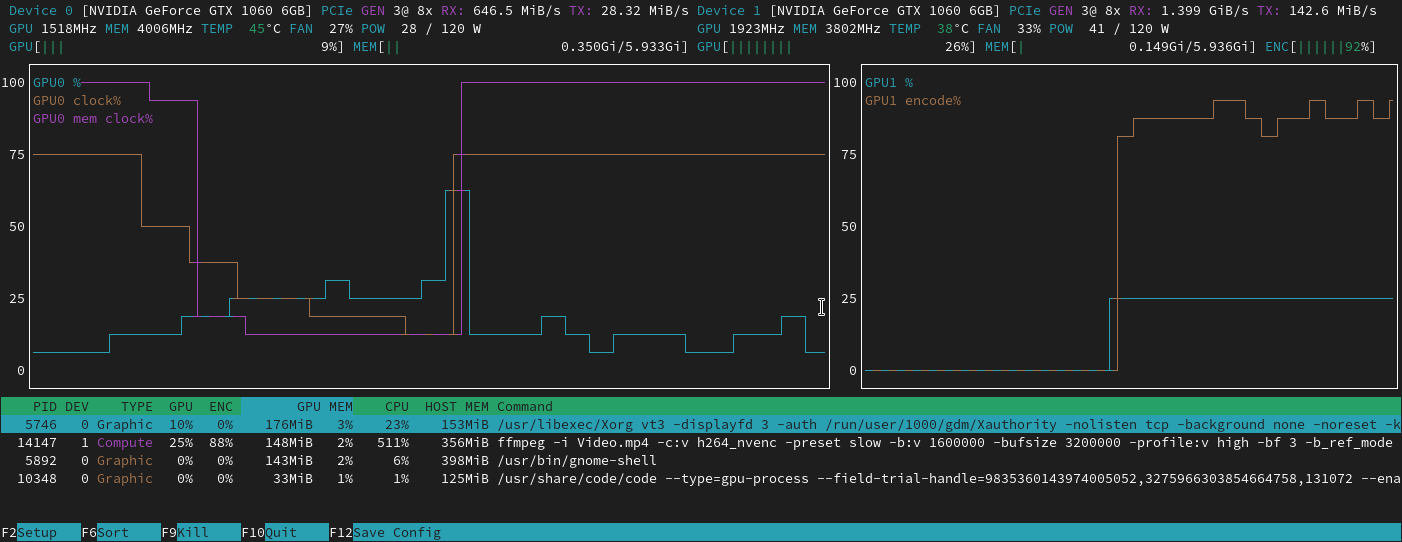
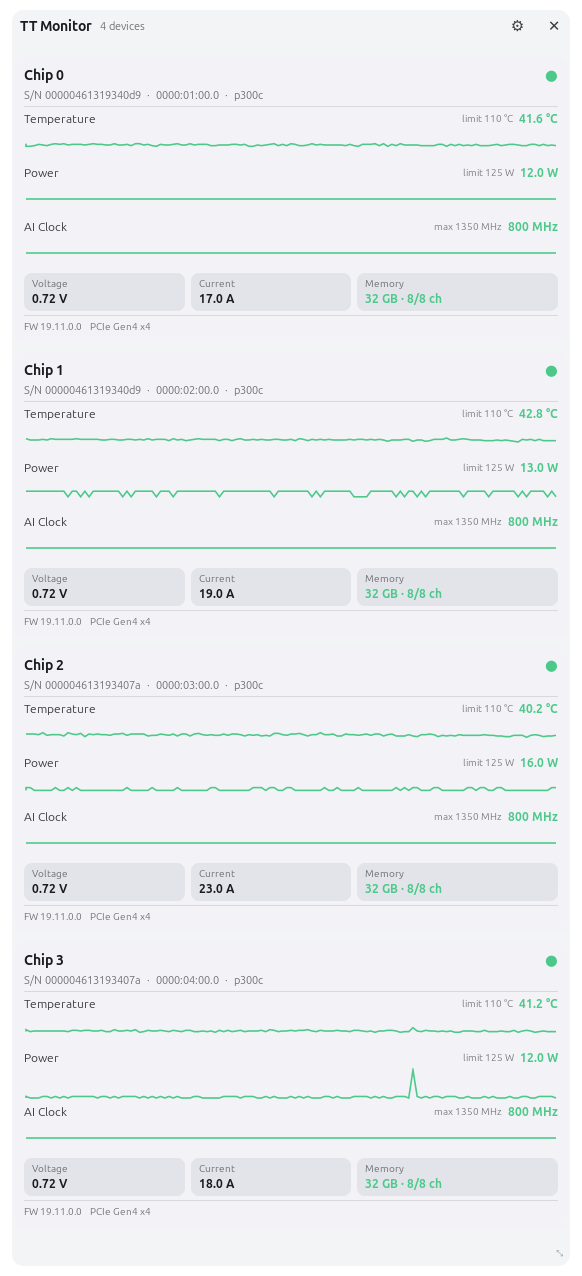
htop-style process monitor for GPUs and AI accelerators. Supports AMD, Apple, Huawei, Intel, NVIDIA,…
🖥 Hardware & System
Drivers, firmware, monitoring, and hardware management
tt-kmd
official
Tenstorrent kernel module driver. The Linux kernel module required to interface with Tenstorrent PCI…
tt-qb-lights
affiliated
Sync your Tenstorrent Quietbox's RGB lighting to accelerator utilization status. Visual feedback for…
blackhole-py
community
Pure Python driver for Tenstorrent Blackhole cards providing direct low-level hardware access withou…
☁️ Cloud & Orchestration
Kubernetes, cloud deployment, and multi-node infrastructure
TT Console
official
Browser-based cloud console for exploring AI on Tenstorrent hardware. Run LLM inference, image and v…
tt-inference-server
official
Production-ready model serving for Tenstorrent hardware with OpenAI-compatible REST API. Supports co…
koyeb/tenstorrent-examples
community
Example applications and deployment configurations for running AI workloads on Tenstorrent hardware …
🔩 RISC-V & Architecture
ISA, simulation, and running Linux on TT silicon
tt-bh-linux
official
Linux demo for the Tenstorrent Blackhole P100/P150 card RISC-V cores. Boot a real Linux kernel on th…
CS Fundamentals on Tenstorrent Hardware
affiliated
Seven-module computer science curriculum taught on real Tenstorrent hardware. Covers RISC-V architec…
tt-sim
community
Community-built Tenstorrent architecture simulator written in Python. Runs without hardware — useful…
🔬 Research & Papers
Academic papers, theses, and HPC experiments
tt-isa-documentation
official
Low-level ISA and microarchitecture documentation for Tenstorrent AI architectures (Grayskull, Wormh…
Exploring spectral element methods on the Tenstorrent RISC-V accelerator
affiliated
The growing availability of commodity RISC-V hardware has sparked interest in its use for High Perfo…
tt-tutorial (HPC)
community
Tutorial on Tenstorrent hardware for HPC researchers from the RISC-V Testbed project at Edinburgh/EP…
🎮 Games & Demos
Creative, playful, and proof-of-concept projects
tt-animatediff
official
Generates short, temporally coherent animated GIFs using the AnimateDiff model on Tenstorrent hardwa…
tt-zork-and-more
affiliated
A Tenstorrent fork of Infocom's Zork I (and more!), running a Z-machine interpreter at least four di…
TT-GoL
community
Conway's Game of Life implemented on Tenstorrent hardware using TT-Metal kernels.
📚 Guides, Tutorials & Education
Getting-started content, blog posts, lessons, courses
tt-installer
official
Install the complete Tenstorrent software stack with one command. Handles drivers, firmware, Python …
Custom Model Training on Tenstorrent
affiliated
Eight-lesson series covering the full custom training workflow on TT hardware: dataset fundamentals,…
Programming Tenstorrent Processors
community
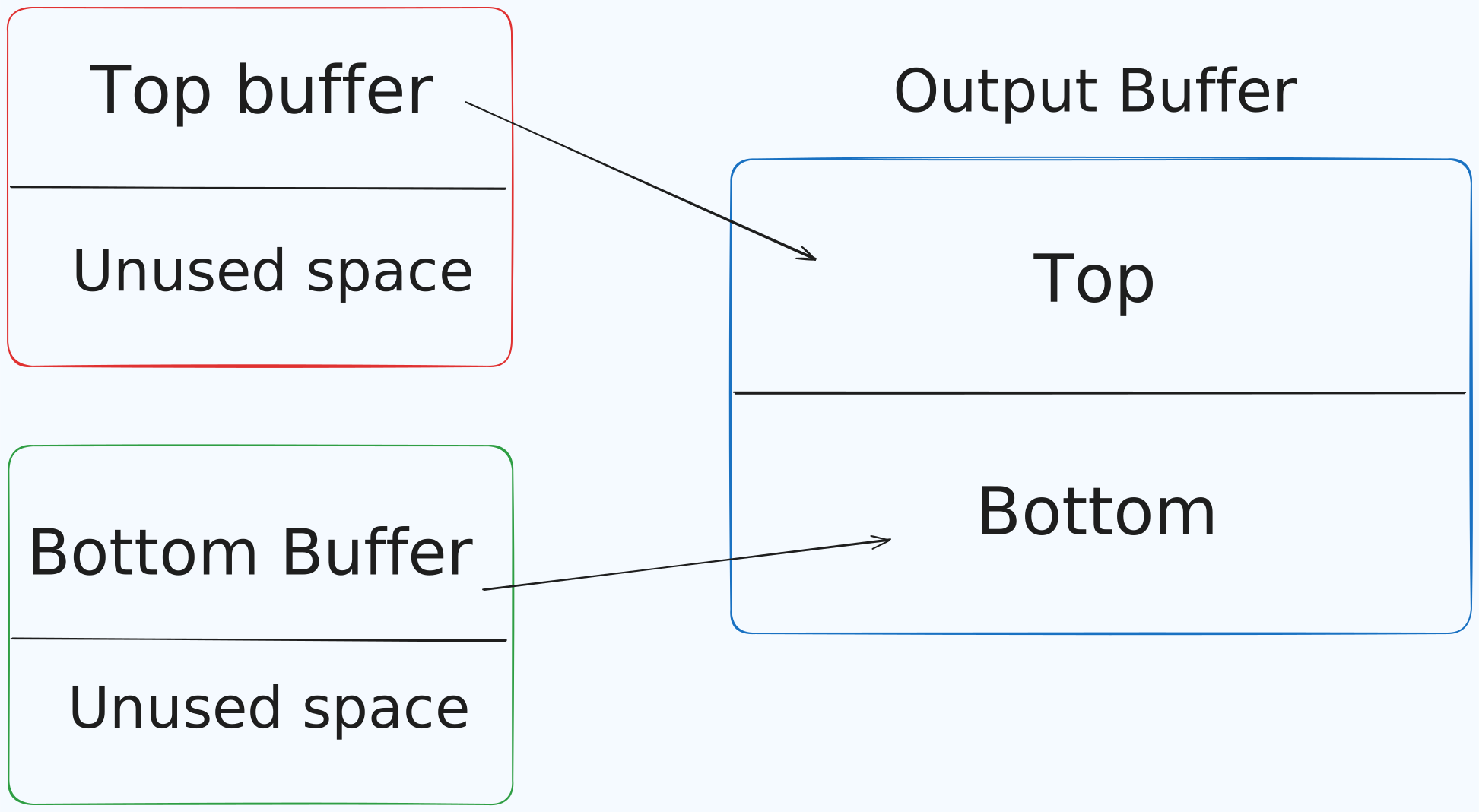
Deep-dive into the Tenstorrent architecture and Metalium programming model — circular buffers, kerne…
✍️ Blogs
Community and affiliated blogs covering Tenstorrent hardware, software, and AI
dev.to/mando222 — Tenstorrent & AI Blog
affiliated
Eric Zietlow's blog covering Tenstorrent hardware, Metalium programming, and AI topics, sharing prac…
Tenstorrent Blackhole Architecture Guide
community
A 6,500-word community deep dive into the Blackhole p100a architecture: the tile model (Tensix, DRAM…
A Gentle Guide: Tenstorrent Card on Arch Linux with Metalium
community
Step-by-step guide to getting a Tenstorrent card running on Arch Linux with the full Metalium stack.…
Fresh from Planet Tenstorrent
Planet Tenstorrent is the ecosystem's live feed — new releases,
articles, papers, talks, and community posts from across the Tenstorrent world,
gathered in one place and updated daily. The latest five:
The new tt report command bundles logs and auto-drafts a support email (.eml file) so filing issues with the Tenstorrent team becomes a one-shot workflow—no more manual attachment wrangling. Beyond that, tt serve gains routing options (--inference-server, --studio, --model-manager) and concurrent deployment with progress visibility, while tt model subcommands now unify served-model introspection (ps, logs) and a hardware-aware community model catalog. The terminal output got a refresh with streaming, new parsing, and cleaner paging, plus fixes for tt-smi discovery in venv installs and consistent model port detection across launchers.
Dstack now supports Hot Aisle bare metal servers with 8×MI300X GPUs—a significant addition for teams running large-scale AMD workloads that benefit from dedicated hardware without VM overhead. Enable bare metal provisioning with bare_metal: true in your Hot Aisle backend config, and you'll see new bare metal instance types appear in dstack offer output; just keep in mind these servers are prepaid for 8-hour blocks and require manual termination in the Hot Aisle console when you're done. The release also patches AWS Capacity Blocks placement group handling, improves gateway SSH reliability under load, and adds NVIDIA B300 support to Vast.ai.
tt-bio 0.13.0 ships a customizable loss surface for BindCraft 2's design loop and comprehensive confidence exports from every structure model — you can now write your own loss terms in Python and reweight or replace any of BindCraft 2's 37 built-in terms, with bindcraft2.check_gradient validating gradients before a campaign spends time on them, and --write_pae now exports full PAE matrices, contact probabilities, and per-model confidence sidecar metadata for eight structure models including ESMFold-2 and AF2-IG for the first time. A new extension surface lets you run your own output head on Boltz-2 or ESMFold-2 folds on Tenstorrent, CPU, or GPU via --head FILE.py:NAME, with an optional per-step trajectory hook—docs/extending.md and examples/custom_head show the paths. Weight-fetching is also corrected: OpenFold3 and OpenBind-0 now download on first use (both Apache-2.0), Protenix-v2 is gated pending license clarity, and CPU-only Boltz-2 folds no longer crash in the confidence step.
The visualizer now ranks your slowest operations by kernel duration right in the graph view, making it trivial to spot the bottlenecks that matter most—click any op in the top-10, -25, -100, or complete list and it pans directly to it. Beyond that, allocation failures are now surfaced in the performance view with full traceability to the operations that failed and the device ops that preceded them, and a raft of fixes shore up the linker between memory and performance reports so comparisons no longer go stale or misreport tensor storage types. Agent tools can now tie performance slowness back to its memory footprint in the model, and late tensor deallocations are called out in Operation Details so you can see which tensors are being held longer than expected.
Quasar instruction encoding got a thorough cleanup in this toolchain update, fixing several cases where the assembler was generating incorrect machine code—worth rebuilding if you're targeting Quasar. On the math side, ldexp with LdexpMode::Correct now behaves as intended on Wormhole and Blackhole, and the descale variants of __builtin_rvtt_sfpstochrn have been split out to eliminate confusion around which builtin does what.
A rare but critical compiler bug that could silently generate incorrect code or crash outright has been fixed—exactly the kind of issue that's hardest to debug when it hits production. The fix shores up code generation stability, so you can deploy with greater confidence that what you compile is what you get.
This site is two old traditions sharing one orbit: an
awesome list and a planet. Open source is an
ecosystem the way space is — moonshot projects igniting into galaxies
of forks and stars, and planet sites keeping the whole universe in
view. (Around here the metaphor is load-bearing: we ship hardware
called Galaxy.) Both traditions are gifts from decades of that
culture, and both deserve some tribute.
🕶 The awesome list
Humans curating links for other humans is the oldest genre on the web —
Yahoo! began life in 1994 as "Jerry and David's Guide to the World
Wide Web", and the volunteer-run
DMOZ / Open Directory Project
kept hand-sorted order for two decades. In 2014, Sindre Sorhus distilled
that instinct into a GitHub-native microformat with
sindresorhus/awesome:
one README, a ruthless curation bar ("only awesome things"), and pull
requests as the editorial process. The
awesome manifesto
turned list-making into a commons — thousands of lists,
lists of lists,
and giants like
awesome-python,
awesome-selfhosted, and
awesome-go.
Synth heads are gloriously covered too:
awesome-musicdsp,
awesome-audio-dsp,
awesome-webaudio, and
awesome-supercollider.
Because the format is halfway to being a database, people have long
rendered lists into websites — tt-awesome just commits to the bit:
every entry is a JSON file, and the README, this site,
data.json, and the feeds are all built from the same source.
🪐 The planet
In the early 2000s, Jeff Waugh and Scott James Remnant wrote
Planet,
a little Python feed aggregator that river-merged a community's blogs
into one page — and free software communities never looked back.
Planet GNOME,
Planet KDE,
Planet Debian,
Planet Gentoo,
Planet Ubuntu,
Planet Fedora (the Red Hat family), and
Planet Mozilla
are all still ticking decades later, many having passed through Sam
Ruby's Planet Venus rewrite along the way. The lineage runs
deeper still: before planets there were blogrolls, and before blogrolls,
web rings —
WebRing was built in 1995 by a teenaged Sage Weil, who grew up to create
Ceph, which is about as open-source-full-circle as a story gets.
Planet Tenstorrent carries that
torch for this ecosystem.
TT-NN operator library and TT-Metalium low-level kernel programming model. The primary SDK for developing on Tenstorrent hardware — from high-level tensor ops to bare-metal RISC-V kernels.
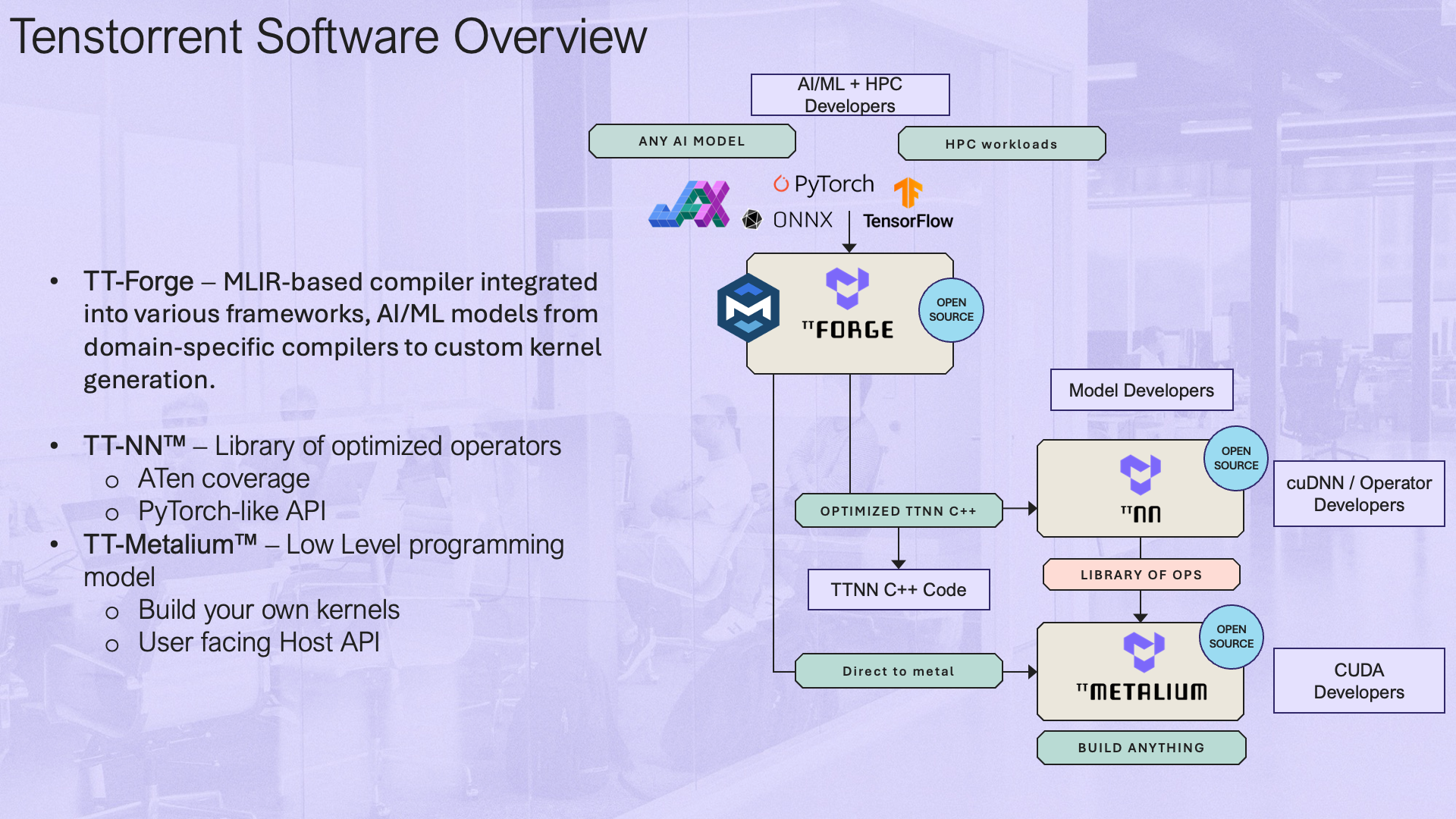
Tenstorrent's MLIR-based compiler frontend. Enables running AI workloads from PyTorch, ONNX, and other frameworks on all Tenstorrent hardware configurations through an open-source, general, and performant compiler.
TT-BUDA: Tenstorrent's original Python compiler and runtime for AI workloads. Legacy stack — tt-forge is the recommended successor, but tt-buda has the largest model demo library.
Tenstorrent MLIR compiler — the core compiler infrastructure shared by tt-forge and other frontends. Handles graph optimization, lowering, and code generation for Tensix hardware.
Fast full-system simulator of Tenstorrent Wormhole and Blackhole hardware. Runs TT-Metalium workloads on any Linux/x86_64 system without physical silicon. Bit-exact results relative to hardware.
Low-level ISA and microarchitecture documentation for Tenstorrent AI architectures (Grayskull, Wormhole, Blackhole) — the authoritative hardware reference beneath the tt-forge / tt-metal software stack.
RISC-V architectural self-checking directed tests — randomly-generated register operands and data with low-level OS code for test scheduling and self-checking, runnable on a RISC-V design or an ISS such as Whisper or Spike. Generated by an internal Tenstorrent tool from the official RISC-V ISA spec.
Production-ready model serving for Tenstorrent hardware with OpenAI-compatible REST API. Supports continuous batching, multiple models, and all TT hardware configurations.
RISC-V Directed Test Framework and Compliance Suite. Comprehensive test infrastructure for verifying RISC-V processor implementations against the specification.
ONNX graph compiler for Tenstorrent hardware. Optimizes and transforms ONNX model graphs for efficient execution on Tensix accelerators. Used as a backend by tt-forge for ONNX model ingestion.
# Changelog

All notable changes to this project will be documented in this file.

The format is based on [Keep a Changelog](https://keepachangelog.com/en/1.0.0/),
and this project adheres to [Semantic Versioning](https://semver.org/spec/v2.0.0.html).

## 3.0.26 - 29/07/25
- Added single tray galaxy reset option
- Bumped luwen from 0.7.5 -> 0.7.10
  - Chip detect now doesn't wait for eth to train for the 6U galaxy's, allowing multi tray resets to happen independently
- Updated readme with the new reset option

## 3.0.25 - 29/07/25
- Added packaging

## 3.0.24 - 04/07/25
- Now users have 2 galay reset modes available
  - glx_reset: resets the galaxy, informs users if there has been an eth failure
  - glx_reset_auto: resets the galaxy upto 3 times if eth failures are detected

## 3.0.23 - 03/07/25
- Bumped luwen 0.7.3 -> 0.7.5 to fix cargo lock compatibilty issue

## 3.0.22 - 02/07/25
- Bumped tt-tools-common 1.4.16 -> 1.4.17
- Bumped luwen 0.7.2 -> 0.7.3
- Bumped smi 3.0.21 -> 3.0.22

## 3.0.21 - 26/06/25

- Added option to not re-init chips after reset
- Updated galaxy 6u reset option from --ubb_reset to -glx_reset
- Removed the a3 arc message before doing a 6u reset, meaning we can reset even when chips are not pcie accessible
- Added eth link check and return failure if any of the eth links have a LINK_INACTIVE_FAIL_DUMMY_PACKET failure

## 3.0.20 - 04/06/25

- Chore - bumped tt-tools-common version to fix driver version check for compatability with tt-kmd 2.0.0

## 3.0.19 - 30/04/25

- Fixed an issue preventing the telemetry thread from being dispatched when the user clicked tab 2

## 3.0.18 - 22/05/25

- Added BH and WH UBB board type support
- Removed the dependency on tt-tools-common for this info

## 3.0.17 - 13/05/25

- Added proper telemetry heartbeat checks for Grayskull

## 3.0.16 - 12/05/25

- Used new ResetTypes from tools-common to simplify reset code
- Added a heartbeat spinner to the telemetry pane. We expect this spinner to update about twice per second. If the spinner is not moving, this indicates new telemetry is not being fetched.

## 3.0.15 - 24/04/25

- Patch for the ubb_reset to just discover local only post reset. Looks like eth port status 2 has been re-used to mean connected and pyluwen waits for it to clear, leading to eth timeout.

## 3.0.14 - 21/04/25

- Added wh ubb reset via command line `tt-smi --ubb_reset`. Intention is that this command line option will be removed and integrated into `tt-smi -r` after we update board detection with the correct external naming.
- Removed some unused imports and code - no functional changes

## 3.0.13 - 21/03/25

- Removed get\_sw\_versions

## 3.0.12 - 21/03/25

- Chore - bumped luwen version to include eth fw version check fix

## 3.0.11 - 13/03/25

- Chore - bumped luwen version to include enable chips with external connections but no routing

## 3.0.10 - 10/03/25

- Chore - bumped luwen version to include protoc lib detection check

## 3.0.9 - 07/03/25

- Chore - bumped luwen v
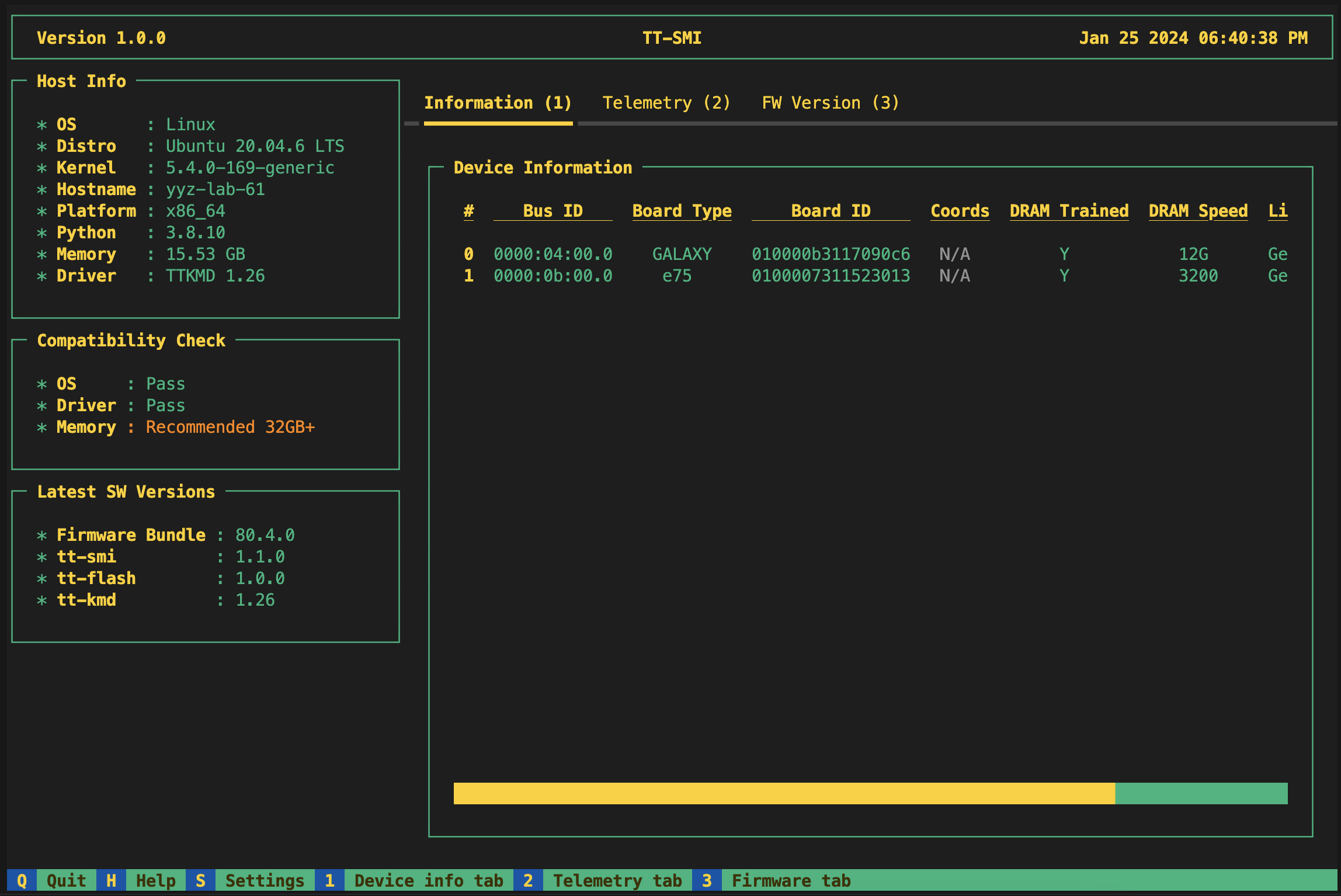
monitoringtelemetrysmihardware-management
Works on
grayskullwormholeblackhole
tt-buda-demos
official
Python · Apache-2.0 · 63⭐ ·
Repository of model demos using TT-Buda. The largest collection of pre-compiled model examples for Tenstorrent hardware — BERT, ResNet, YOLO, GPT-2, Whisper, and many more.
Python-based DSL that sits between TT-NN and TT-Metalium — expresses custom fused kernels with progressive disclosure, compiling directly to Tensix. Ships an integrated functional simulator (no hardware needed), line-by-line performance metrics, and AI-agent-friendly tooling. Two packages: tt-lang (compiler + hardware, requires ttnn) and tt-lang-sim (simulator only, works on Linux/macOS without Tenstorrent hardware).
# Changelog

All notable changes to TT-Lang will be documented in this file.

The format is based on [Keep a Changelog](https://keepachangelog.com/en/1.0.0/),
and this project adheres to [Semantic Versioning](https://semver.org/spec/v2.0.0.html).

## Version 1.1.1

### Compiler

- Fix for live-interval boundary computation (issue [#536](../../issues/536))
- Fix for all-zero results in FP32 reductions (issue # [#533](../../issues/533))
- Fix for inferred `pop` and `push` (issues [#536](../../issues/536), [#554](../../issues/554))
- Fix for write pointer tracking on pipe sender accross iterations (issue [#578](../../issues/578))
- Fix to report data type mismatch error
- Fix to report DFB over allocation error (issue [#511](../../issues/511))
- Support for pipenet predicates `is_src`, `is_dst` and `is_active` (issue [#541](../../issues/541))
- Support for `ttl.math.typecast`

### Simulator

- Support for inferred `pop`, `push` and `copy`'s transfer handle `wait`
- Support for pipenet predicates `is_src`, `is_dst` and `is_active`
- Support `all_gather`
- Support `bfloat8_b`
- Improved/actionable error messages
- Improved performance by simulating math in FP32

### Infrastructure

- TT-Lang installable with `pip install tt-lang` for full installation and `pip install tt-lang-sim` for simulator only
- [Matmul benchmarks](benchmarks/matmul/README.md)

## Version 1.0.0

### Compiler

- Support `+=` syntax in conjunction with dot product (`@`) lowered to packer L1 accumulation
- Support implicit temporary compute-kernel-local DFBs
- Support `ttl.Pipenet`
- Support implicit `ttl.Block.push` and `ttl.Block.pop`
- Support implicit `ttl.Transfer.wait`
- Support for `expm1`, `exp2`, `ceil`, `sign`, `gelu`, `silu`, `hardsigmoid`, `square`, `softsign`, `signbit`, `frac`, `trunc` in `ttl.math`

### Simulator

- Support for `ttl.GroupTransfer`
- SPMD and mesh device simulation support
- Support for `ttnn.all_reduce` CCLs
- Use tracing to report statistics with `tt-lang-sim-stats`
- Remote L1 reads/writes statistics

### Examples and documentation
- Matmul tutorial

## Version 0.1.8

### Compiler

- Support for dot product operator (`@`) with lowering to [`ckernel::matmul_block`](https://docs.tenstorrent.com/tt-metal/v0.55.0/tt-metalium/tt_metal/apis/kernel_apis/compute/matmul_block.html)
- Support for fusing matmul and certain elementwise operations
- Support lowering to `pack_tile_block`
- Support for `ttl.math.fill`, `ttl.math.reduce_sum`, `ttl.math.reduce_max`, and `ttl.math.transpose`
- Support for arbitrary sub-blocking including dot product K-dimension to allow maximizing L1 usage and reuse
- Support for `sin`, `cos`, `tan`, `asin`, `acos`, `atan` in `ttl.math`
- Support for L1 sharded tensors
- Support for tensors with BF8 data type
- SPMD support (`ttnn.open_mesh_device`)

### Simulator

- Track L1 space and number of DFBs usage and warn when exceeded
- Support for tensors with row-major layout
- Support for L1 sharded tensors

### Examples and documentat
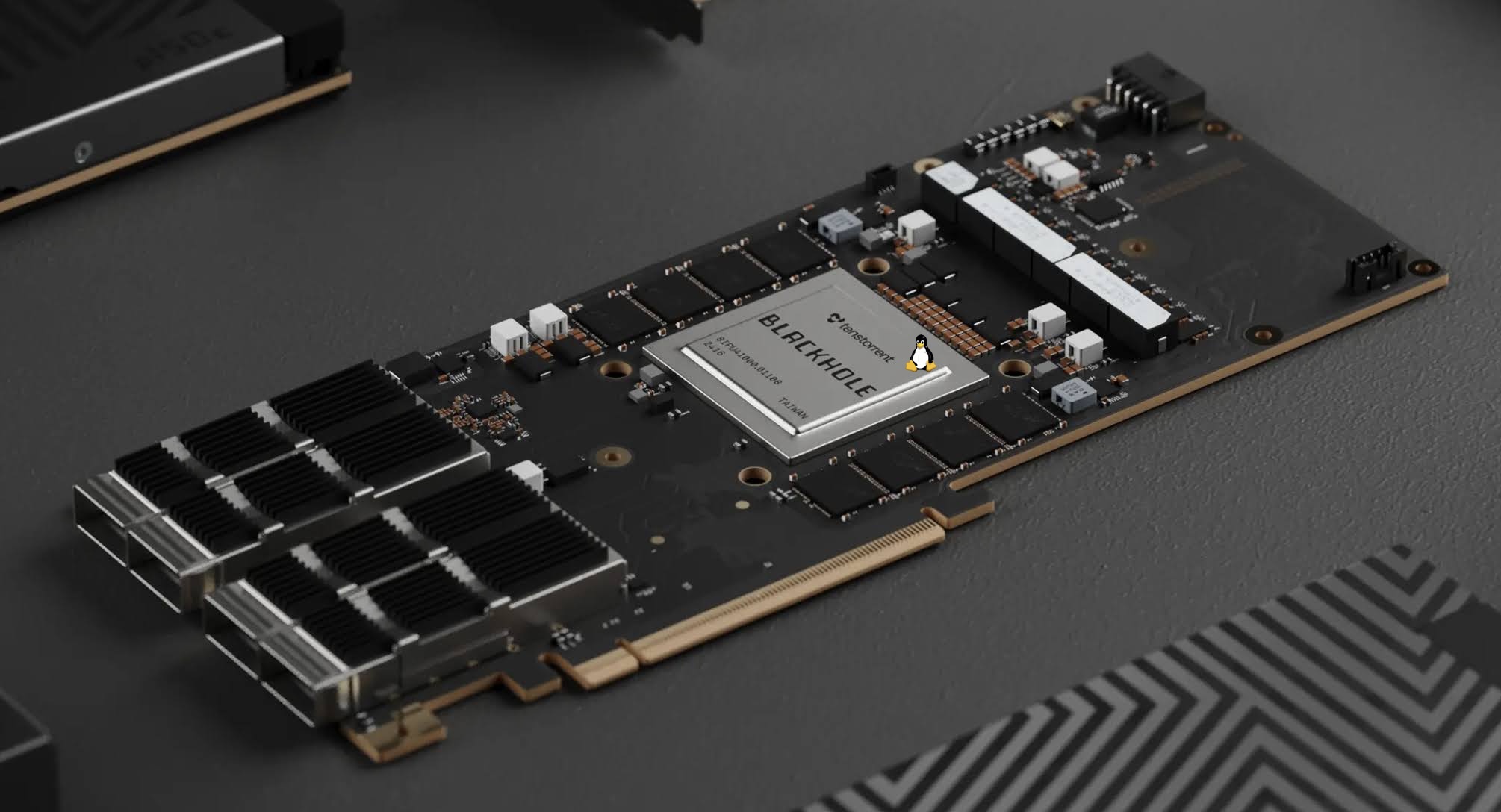
Linux demo for the Tenstorrent Blackhole P100/P150 card RISC-V cores. Boot a real Linux kernel on the 16 high-performance RISC-V cores built into the Blackhole chip.
Comprehensive tool for visualizing and analyzing model execution on Tenstorrent hardware. Interactive graphs, memory plots, tensor details, buffer overviews, operation flow graphs, and multi-instance support.
Tenstorrent Low-Level Kernels: the C++ library that directly programs the RISC-V cores inside each Tensix compute engine. TRISC0 (unpack), TRISC1 (math/FPU/SFPU), and TRISC2 (pack) are all programmed through this layer — it is the interface between TT-Metal kernel code and bare silicon.
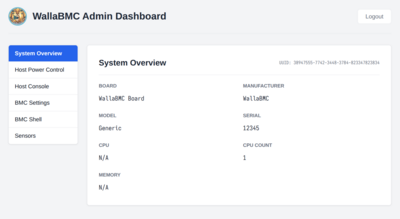
Lightweight BMC (Baseboard Management Controller) for STM32 and similar MCUs, with Web UI, Redfish API, and HTTPS support. Built on Zephyr RTOS. Used in Tenstorrent systems.
Web-based GUI for deploying and chatting with AI models on Tenstorrent hardware. Handles all technical setup automatically — deploy models, run inference, and explore capabilities through a simple browser interface.
# Changelog

## [0.9.13] - 2026-10-02

### Changed

RTL simulator IP partitioning: one simulator run serving several chips via ip_layout.yaml.
RiscReset component interface.
Host memory channels set automatically based on topology.
IPMI reset improvements.

## [0.9.12] - 2026-09-28

### Changed

Simulator topology discovered through the silicon path.
IoOrdering parameter on Cluster read and write.
Quasar ATT address map.
Simulation servers whose host is gone are no longer reported.

## [0.9.11] - 2026-09-21

### Changed

TLBManager removed in favor of IoWindow; per-arch silicon TTDevice subclasses deleted.
Runtime telemetry and clock queries served by DeviceFirmware.
Optional cluster_id in the cluster descriptor.
Latest supported CMFW raised to 19.14.

## [0.9.10] - 2026-09-09

### Changed

Base API alignment: TTDeviceModel, DeviceFirmware, DmaInterface, IoWindow, MutexInterface, SystemMemoryAllocator.
SysmemBuffer ownership and host copy APIs; dma-buf export for RDMA.
Locks backed by KMD resource locks; tt-kmd-lib extracted.
Stateless NOC across TTDevice and SocDescriptor; xy_pair overloads removed.
Shared simulation server (sim_server) with client/host mode over sockets.

## [0.9.9] - 2026-07-09

### Changed

Blackhole runtime telemetry buffer accessors.
Precise ETH_LIVE_STATUS based APIs and Blackhole harvesting utility.
TTSim cluster descriptor discovered from simulator directory.

## [0.9.8] - 2026-07-01

### Changed

Per-op MMIO timeout for TLB-mapped device access.
set_power_state renamed to set_clock_state in TTDevice.
Simulation client mode over SimulationClient.

## [0.9.7] - 2026-06-26

### Changed

Device health errors returned from TopologyDiscovery.
Dedicated EthernetBroadcast and noc_multicast for remote chips.
DeviceTimeoutError exception type.
DRAM retrain on BIST failure.

## [0.9.6] - 2026-06-03

### Changed

ARM (aarch64) builds and fixes.
TTSimChip and RtlSimulationChip merged into SimulationChip, with multichip support.
TensixSoftResetOptions removed.
Warm reset with remote IO failure recovery.

## [0.9.5] - 2026-05-12

### Changed

Hardware hang detection for NOC and PCIe.
Tracy profiler integration with instrumentation across TLB, PCIe and sysmem paths.
DeviceProtocol ported to TTDevice, including DMA migration.
SocDescriptor split into static (SocArchDescriptor) and runtime parts.
LITERAL coordinate system in CoreCoord.
Multicast to all TENSIX cores.
SMN support.
SWEmuleChip software emulation chip and Quasar simulation support (incl. 4GB TLB).
Unified UmdException/UMD_ASSERT/UMD_THROW error handling across the codebase.

## [0.9.4] - 2026-03-18

### Changed

TopologyDiscoveryOptions refactoring.
TopologyDiscoveryOption to retrain ETH links on 6u.
TLBs for TTsim.
DRAM retrain support.
DeviceProtocol changes.
Simulator in TTDevice changes.
ETH heartbeat check.

## [0.9.3] - 2026-02-24

### Changed

Sigbus safe read write API.
Remove 4U related code.
Implement BH SPI as well, so full SPI support.
P150 expects harvested core
user-mode-driverumdhardware-interface
Works on
grayskullwormholeblackhole
tt-system-firmware
official
C · Apache-2.0 · 45⭐ ·
System firmware for Tenstorrent hardware. Low-level system initialization and control firmware that runs on-device.
TVM for Tenstorrent ASICs. Brings the Apache TVM compiler stack to Tenstorrent hardware, enabling model compilation from TensorFlow, PyTorch, ONNX, and more.
Optimized training recipes for a variety of ML models on Tenstorrent hardware, powered by the TT-Forge compiler stack. Reference implementations for fine-tuning and training from scratch.
Tenstorrent backend for vLLM, built on vLLM's standard plugin mechanism — install it alongside vLLM and TT hardware registers itself as a platform whenever `ttnn` is importable. Self-contained: model registration, platform detection, scheduling, worker execution, model loading, async decode, and data-parallel/multi-lane execution all live in the plugin, so nothing Tenstorrent-specific has to land in vLLM core.
# Changelog

All notable changes to this project will be documented in this file.

The format is based on [Keep a Changelog](https://keepachangelog.com/en/1.0.0/),
and this project adheres to [Semantic Versioning](https://semver.org/spec/v2.0.0.html).

## 1.2.11 - 17/06/2025

### Updated

- Updated mesh coord generation to be connection type agnostic
- Added failure and exit if mesh type detected, but not enough connections
- Added warning in README about lack of supoort for BH and 6U boards

## 1.2.10 - 05/06/2025

### Updated

- Bumped tt-tools-common version to fix driver version check for compatability with tt-kmd 2.0.0

## 1.2.9 - 30/05/2025

### Updated

- Bug fix for https://github.com/tenstorrent/tt-topology/issues/39. Now the tool will use a DFS longest path to determine a linear layout if its not a fully connected graph.
- Updated initial device detection - now it needs full noc access for octopus and list options

## 1.2.8 - 08/05/2025

### Updated

- Fixed issue where tool would fail when PCI interfaces don't start from ID 0
- Now using actual PCI interface IDs from devices instead of assuming sequential numbering

## 1.2.7 - 07/05/2025

### Updated

- Use tools-common 1.4.15
- Use type checking in octopus reset

## 1.2.6 - 05/05/2025

### Updated

- Bug fix: added "ignore-eth" flag to first chip detect to avoid eth training loops forever and truly detect pcie only chips
- Chore: bumped luwen

## 1.2.5 - 15/04/2025

### Updated

- When flashing to isolated mode, we now flash the WH ethernet ports to a disabled state,
  in order to prevent their use.

## 1.2.4 - 02/04/2025

### Updated

- You can now run `tt-topology -l isolated` to flash cards to the default (non-connected) state
- Users are now warned about missing or loose cables

## 1.2.3 - 21/03/2025

### Fixed

- Bumped luwen (0.6.2 -> 0.6.3) to include eth version check bug for TG setup

## 1.2.2 - 13/03/2025

### Fixed

- Bumped luwen version to make it more robust against eth fw updates

## 1.2.1 - 13/03/2025

### Fixed

- Moved the spi reads after the reset to increase stability during M3 L2R copy
- Bumped luwen version

## 1.2.0 - 06/03/2025

### Fixed

- Updated how local eth board info is calculated to make it agnostic to eth fw version
- bumped tt-tools-common version
- Added traceback printing when catching exceptions in main.

## 1.1.5 - 14/05/2024

### Updated

- Bumped luwen (0.3.8) and tt_tools_common (1.4.3) lib versions
- Removed unused python libraries

## 1.1.4 - 25/03/2024

### Fixed
- Changed detect_chips with detect_chips_with_callback to enable detailed debug info.

## 1.1.3 - 22/03/2024

### Fixed
- Bumped tt-tools-common version to avoid pip discrepancy.

## 1.1.2 - 22/03/2024

### Fixed
- Fixed command line bug when no args are provided.

## 1.1.1 - 21/03/2024

### Fixed
- Fixed reference to pyluwen lib

## 1.1.0 - 12/03/2024

### Added
- Octopus Configuration (4 n150s connected to 1 galaxy)


## 1.0.2 - 12/03/2024

### Fixed
- Dependency bug with tt_tools
topologyethernetmulti-cardrouting
Works on
wormholeblackhole
SFPI
official
C++ · Apache-2.0 · 16⭐ ·
Tenstorrent SFPU programming interface — TT-enhanced RISC-V GCC and binutils plus header files for programming the Tensix SFPU (vector engine) from kernel code. The compiler toolchain underneath TT-Metalium's SFPU ops.
A shared repository of model implementations used across TT-Forge frontends — a single source of truth for the models used in testing and benchmarking, rather than duplicating them across frontend repos.
# Changelog

All notable changes to this project will be documented in this file.

The format is based on [Keep a Changelog](https://keepachangelog.com/en/1.0.0/),
and this project adheres to [Semantic Versioning](https://semver.org/spec/v2.0.0.html).

## Unreleased

### Added

- `flash`: `--update-boot-images` writes the bundle's bootloader and recovery
  images even when the board already holds the same ones, for provisioning and
  board recovery.

### Changed

- `flash`: the boot-critical images (`cmfw`, `safeimg`, `safetail`, `failover`)
  and the ROM and failover descriptor tables are now left alone when the board
  already holds the same content, so a routine update no longer opens a
  power-loss window on the path by which a board boots at all. Whether an image
  is the same is decided by the SHA-256 and key hash that `imgtool` records in
  it, because signing is not reproducible: two builds of the same source differ
  only in the trailing signature. Pass `--update-boot-images` for the previous
  behaviour of writing them unconditionally.

### Fixed

- `flash`: a P300 chip running recovery firmware publishes no board id, so the
  pairing check filed it as not a P300, left its sibling alone in a group of
  one, and dropped both halves of the card from the flash list -- refusing the
  board because of the chip that most needed flashing. Such a chip is now
  identified by its PCI subsystem id, which carries the same UPI whatever the
  chip is running.
- `boot_fs`: `tt_boot_fs_fd.image_tag_str()` compared each `c_uint8` tag byte
  against the string `"\0"`, which never matched, so NUL padding was included in
  the decoded tag. Tags shorter than 8 bytes (e.g. `cmfw`) now compare correctly.
  This makes `read_tag` robust across the multi-table boot filesystem layout
  (ROM, failover, and mutable descriptor tables).

## 3.4.0 - 30/07/25

- Bump pyyaml 6.0.1 -> 6.0.2
- Improve error message formatting
- No longer have to use --force for flashing BH cards

## 3.3.5 - 03/07/25

- Bump luwen 0.7.3 -> 0.7.5

## 3.3.4 - 02/07/25

- Bump tt-tools-common 1.4.16 -> 1.4.17
- Bump luwen 0.6.4 -> 0.7.3

## 3.3.3 - 05/06/2025

- Bumped tt-tools-common version to fix driver version check for compatability with tt-kmd 2.0.0

## 3.3.2 - 14/05/2025

- Bump tt-tools-common version to latest

## 3.2.0 - 12/03/2025

### Updated

- luwen version bump to bring inline with tt-smi; provides stability fixes

## 3.1.3 - 06/03/2025

### Added

- luwen version bump to include bh arc init checks

## 3.1.2 - 28/02/2025

### Added

- Support for more BH cards: p100a, p150, and p150c

## 3.1.1 - 06/01/2025

### Updated

- Bumped luwen version to accomodate Maturin updates

## 3.1.0 - 29/10/2024

### Added

- Support for flashing the BH tt-boot-fs file format
- Bumped luwen version to 0.4.6 to allow resets when chip is inaccessible

## 3.0.2 - 17/10/2024

### Fixed
- Unbound variable when exception is thrown when getting current fw-version

## 3.0.1 - 16/10/2024

### Changed
- B
firmware-updateflashutility
Works on
grayskullwormholeblackhole
tt-toplike
official
Rust · Apache-2.0 · 14⭐ ·
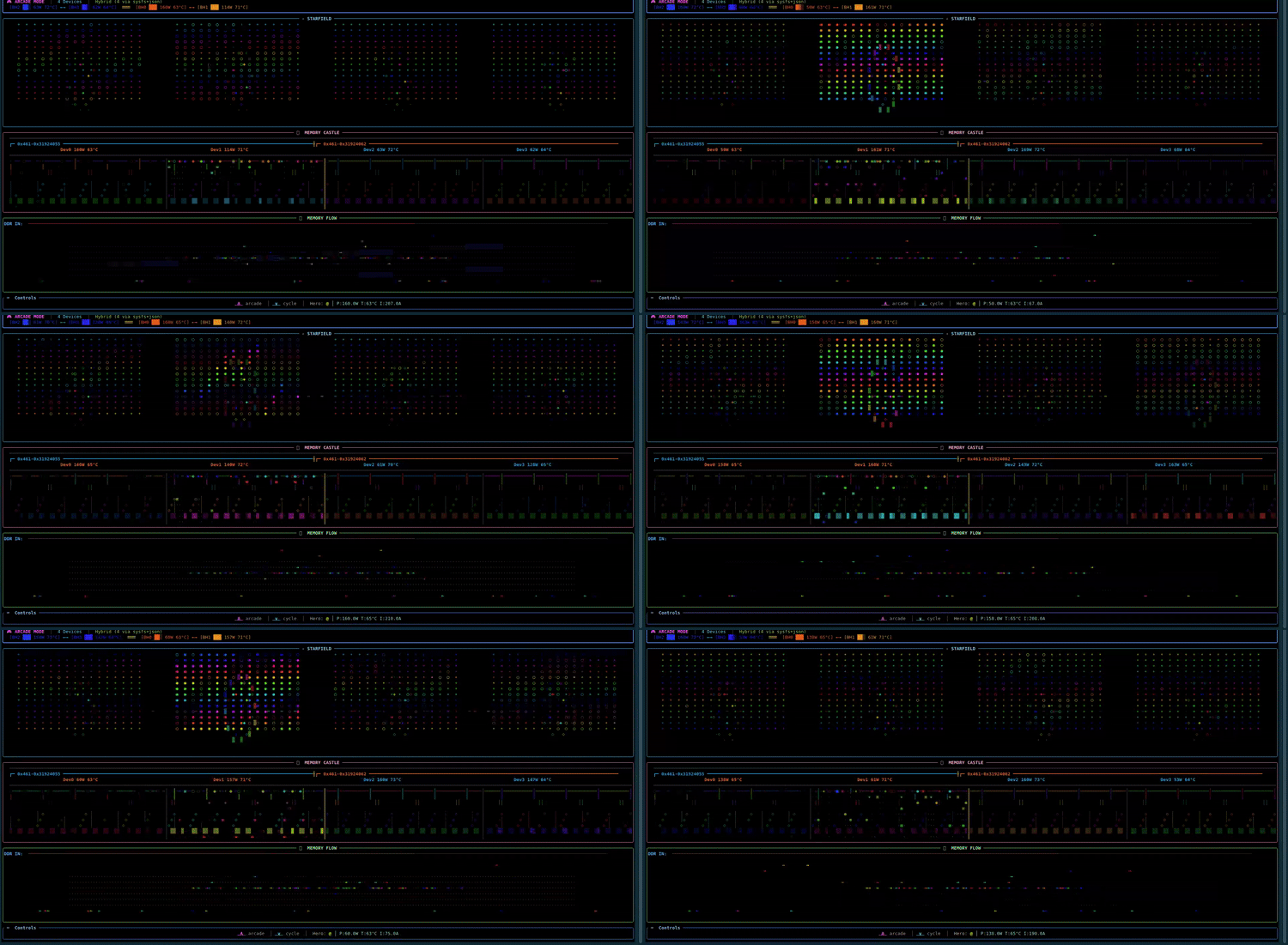
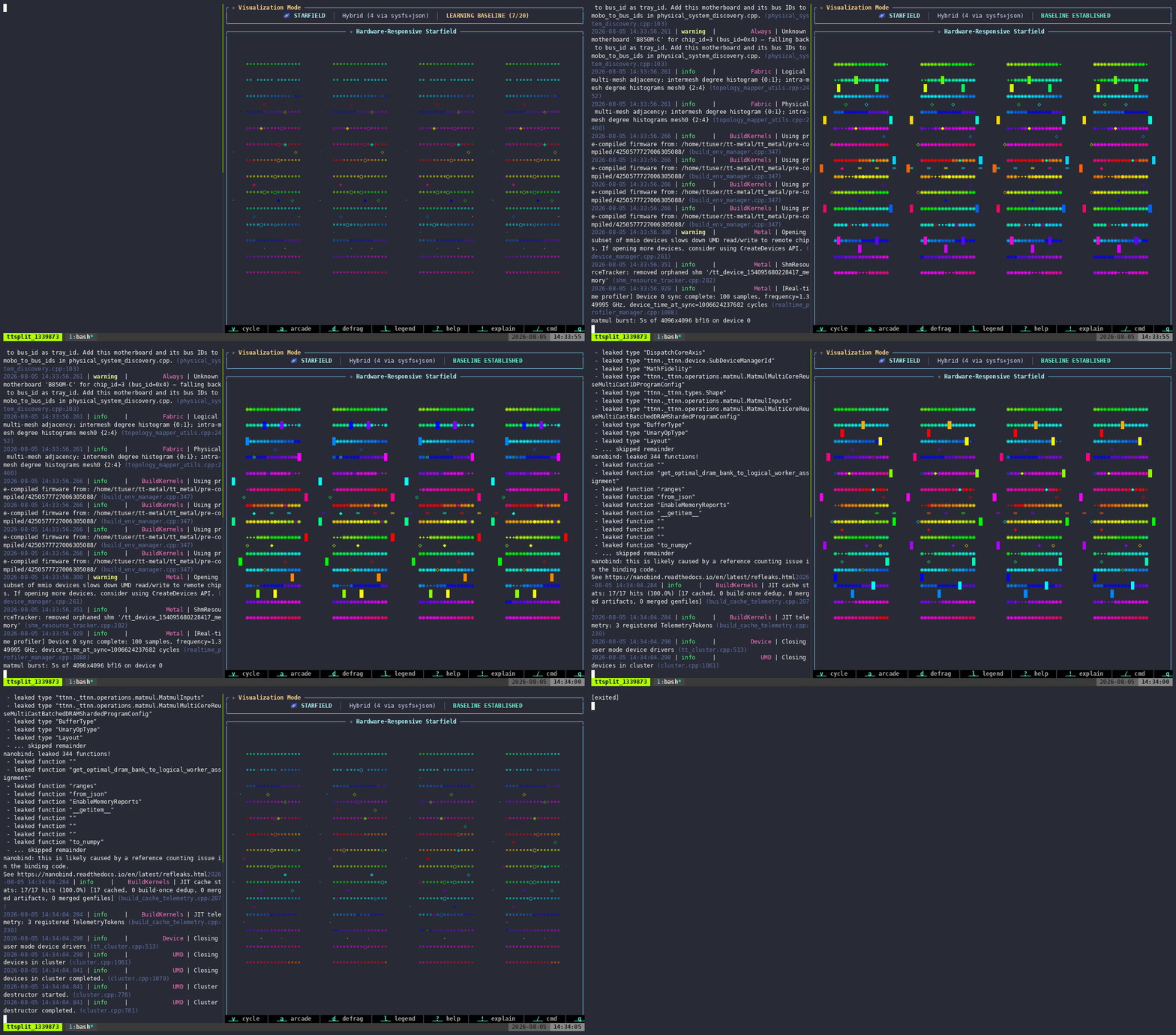
A vibrant htop-style visualizer for Tenstorrent hardware written in Rust. Real-time process and utilization view for TT accelerators.
# Changelog

The **canonical, complete release log lives in [`debian/changelog`](debian/changelog)** —
that's the file the `.deb` packages are built from and where every release is
recorded in full. This file is a friendly pointer plus a summary of the most
recent releases; it deliberately does not duplicate the whole history.

To see everything:

```bash
less debian/changelog          # full history
git tag                        # released versions
```

## Recent releases

Releases 0.11.1 through 0.13.9 are recorded only in `debian/changelog`; this
list is a summary and is not kept for every release.

### 0.13.10
- **Add**: Inference view (`i`) shows the port and chips each model runs on,
  for example `:8000 · chips 0,1`, on each roster row or in a header line for a
  single model.
- **Add**: `--tt-smi-reset-behavior` (`ignore`, `inform` default, `dazzle`,
  `demo`). A `tt-smi -r` in another terminal shows in the status bar of every
  view. `dazzle` adds a takeover box with one of five animations (Quiet
  Notice, 128 Blackholes, a BBS sysop chatbot, TT-TREKLIKE, Silly Cetacean);
  `demo` plays all five at start and on every real reset.
- **Change**: the legend (`l`) and explain (`!`) text for the Training,
  Inference, HivemindSweeper, Insights, Defrag and Memory Castle views matches
  what they draw now; the Help panel shows the reset status segment.

### 0.11.0
- **Add**: Training view (`t`) — a full-screen visualization of a live
  tt-train run, drawn as the network it is: a character grid of transformer
  blocks and attention heads fed by token particles, a loss "mountain range"
  under a twinkling aurora nightscape that opens up as the model converges,
  plus chip telemetry alongside it.
- **Auto-attaches with no command**: scans running processes for a tt-train
  example binary (`nano_gpt`, `mnist_mlp`, `linear_regression`), then resolves
  `/proc/<pid>/fd/1` to find and tail that process's log. Checkpoint saves
  are detected by mtime on the run's rolling checkpoint file.
- **Honest limitation**: tt-train's per-step stream can only be tailed if its
  stdout was redirected to a real file at launch (`> train.log`). If fd 1 is
  a pipe or tty, retroactively reading it is an OS-level impossibility, not a
  gap in this tool — the view says so and falls back to what it can still
  see (process liveness, chip telemetry, and checkpoint mtime) rather than
  drawing a fake loss curve. Gradient norms, MFU, and throughput counters
  aren't emitted live either, so the view derives tokens/sec and ETA only
  from what it can actually read.
- Nine independent color channels (loss magnitude, run-history timeline,
  loss-delta direction, forward/backward sweep cadence, cache compile/steady
  state, checkpoint bursts, plus chip temp/power) — see the new legend and
  explain overlays.

### 0.10.3
- **Security fix**: a direct-vLLM host process's own `PATH` was forwarded
  onto the `sh` the monitor spawns to probe it — a bare `Command::new("sh")`
  lookup re
monitoringhtoprustreal-time
Works on
wormholeblackhole
Tenstorrent Skills
official
Python · Apache-2.0 · 13⭐ ·
Official agent-skill marketplace for Claude Code and Codex, aimed at tt-metal, TTNN, Metalium, and model work. A `tt-skills` finder plugin recommends and installs the rest with your approval: `tt-autodebug` (AutoDebug/AutoTriage investigate bugs and hangs, AutoFix repairs them), `tt-model-bringup` (an eleven-stage path from a Hugging Face decoder through TTNN to vLLM benchmarking), `tt-review-skills` (PR review for TTNN, Metalium, LLK, multi-chip, and L1 changes, also pinnable in gh-aw workflows), and `tt-debug-tools` (drives tt-triage, dprint, and watcher).
End-to-end AI applications running on Tenstorrent AI accelerators. Complete application examples from retrieval-augmented generation to image generation pipelines.
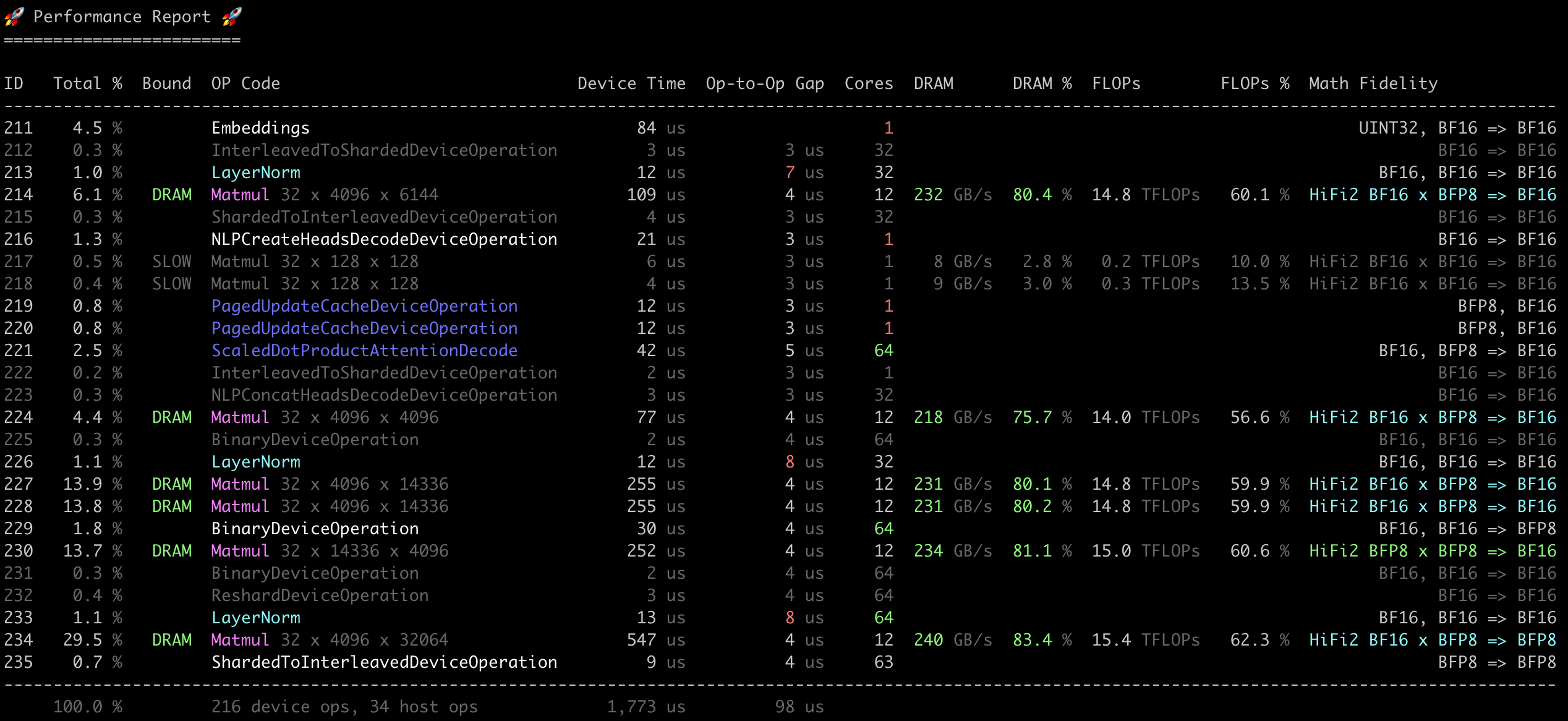
Performance report analysis tool for Tenstorrent Metal operations — analyzes perf traces to surface throughput, bottlenecks, and optimization opportunities.
48 interactive lessons covering the full Tenstorrent developer path — from hardware detection to custom training — with click-to-run commands and hardware auto-detection. Available in VSCode and code-server.
# Changelog

All notable changes to the TT-VSCode-Toolkit will be documented in this file.

The format is based on [Keep a Changelog](https://keepachangelog.com/en/1.0.0/),
and this project adheres to [Semantic Versioning](https://semver.org/spec/v2.0.0.html).

---

## [0.1.29] - 2026-09-07

Correctness pass on what a TT-QuietBox 2 actually ships. The three-path venv
activation blocks added in 0.1.25 offered `~/.tenstorrent-venv` as the "QB2
pre-installed" environment for TT-NN and vLLM, and described a QB2 as "4
independent single-chip devices". Neither claim is true, and this release
corrects both everywhere they were found — including in this repo's own
`CLAUDE.md`, `llms.txt`, and two lessons outside the original diff
(`content/pages/FAQ.md`, `monkeypatch-ttnn.md`) that had never been touched
by the earlier topology/venv corrections this built on.

Verified against `tt-installer`'s `install.m4`, the published `tt-metalium`/
`tt-metalium-models` GHCR image configs, `tt-inference-server`'s `run.py`,
and tt-metal `main` — plus live end-to-end testing on a QB2-equivalent
board — rather than other Tenstorrent docs, which largely descend from the
same stale source note this release supersedes.

### Fixed

**`~/.tenstorrent-venv` is not a TT-NN or vLLM environment.** `tt-installer`
only ever installs `tt-smi`, `tt-flash` and (opt-in) `tt-topology` into it, so
`import ttnn` and `import vllm` both fail there. TT-NN lives **only** inside
the TT-Metalium container (`tt-metalium`, where `python3` is
`/opt/venv/bin/python3`); vLLM runs in a container `tt-inference-server`
launches. Corrected everywhere this was asserted or assumed:
- The "QB2 pre-installed image" activation line in all 11 TT-NN blocks across
  `explore-metalium`, `video-generation-ttmetal`, `animatediff-video-generation`,
  `cookbook-game-of-life`, `cookbook-mandelbrot`, `cookbook-particle-life`,
  `cookbook-image-filters`, `cookbook-audio-processor`, and the four lessons
  that used it as a premise (`lfs-00-intro`, `lfs-05-train-and-run`,
  `ct1-understanding-training`, `ct4-finetuning-basics` — their `ttml`-needs-a-
  source-tree conclusions were already correct; only the premise changed).
- `tt-installer`'s own "may not include the container wrapper" framing —
  backwards: a QB2 *has* the wrapper (it's the only way to reach TT-NN) and
  has no host-side TT-NN. Its "Test TT-Metalium" button and pytest demo
  example were also broken independent of this: missing `-c` (so `bash` tried
  to run the whole command string as a filename), a bare `ttnn.__version__`
  that doesn't exist on the built package (now `getattr(ttnn, "__version__",
  "import OK")`), and — for the demo — the wrong container and a Blackhole
  demo path that moved in tt-metal's January 2026 reorg (now
  `tt-metalium-models` + `models/demos/vision/segmentation/ufld_v2/blackhole`,
  with `--install-metalium-models-container` named as off-by-default).
- `vllm-production`'s new "On a QB2 — read this first" section (pointing a
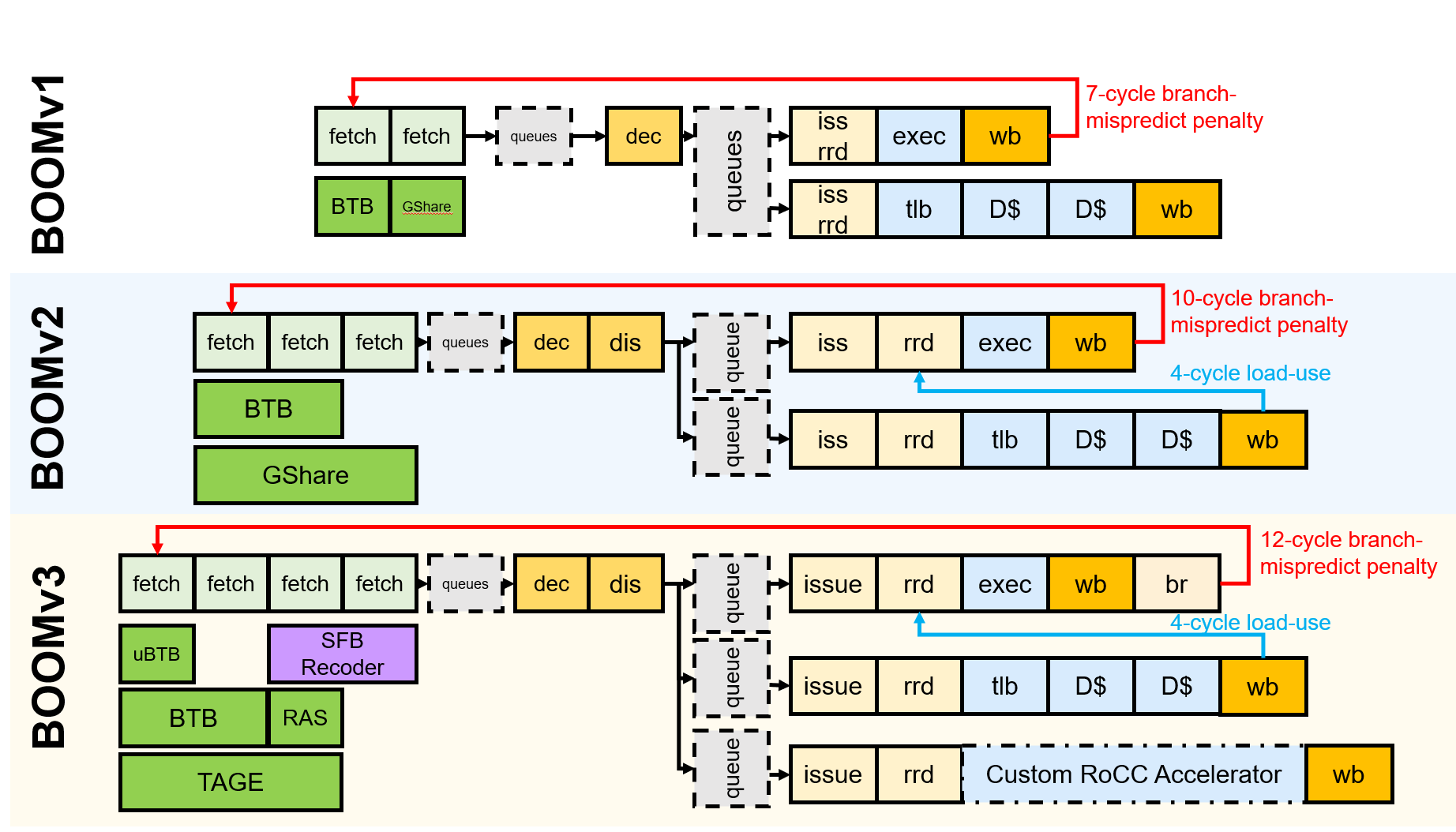
Cycle-level, execution-driven RISC-V CPU performance model built on Sparta (MAP) with Whisper supplying functional execution, so it runs real ELF binaries — CoreMark, Dhrystone — to completion. The pipeline is YAML-configurable across in-order/out-of-order execution, issue policy, execute granularity, write-port arbitration, and bypass paths, with a modeled L1 I$/D$ plus optional unified L2, per-unit logging, stats reports, and Konata pipeline visualization.
Distributes model bundles over the Hugging Face Hub and serves them on Tenstorrent cards — `tt-model serve <org>/<model>` pulls and installs a bundle, then launches the Tenstorrent vLLM plugin's OpenAI-compatible server. A bundle carries or pins its own serving stack, either as an OCI container image (v5.1, the supported path) or as a per-model venv built from pinned wheels (v6 thin, beta), and records the weights' upstream HF repo instead of shipping them, so the host needs only a card and its firmware. Formerly `tt-kernel` / tt-kernel-package-manager, when bundles were precompiled tt-metal kernel caches. Explicitly experimental — the bundle format and APIs may change without notice.
Shared helper library of common utilities used across Tenstorrent system tools such as tt-smi, tt-flash, and tt-topology. A dependency rather than a standalone tool.
# Changelog

All notable changes to this project will be documented in this file.

The format is based on [Keep a Changelog](https://keepachangelog.com/en/1.0.0/),
and this project adheres to [Semantic Versioning](https://semver.org/spec/v2.0.0.html).

## 1.4.17 - 02/07/2025

### Changed
- Loosened requirements on pyproject.toml to make it more compatible in different venvs

## 1.4.15 - 05/05/2025

### Changed
- parse\_reset\_json now returns a ResetInput with stricter typing

## 1.4.14 - 04/02/2025

### Added
- New flags in reset config file generation to disable sw\_version reporting

## 1.4.13 - 23/1/2025

- Removed nr\_hugepages count from compatibility, as hugepages allocation is tricky
  and deserves its own widget elsewhere.

## 1.4.12 - 16/1/2025

- Added TTHostCompatibilityMenu to replace Host Info and Compatibility boxes
- Added a count of nr\_hugepages to the TTHostCompatibilityMenu

## 1.4.11 - 30/12/2025

- Updated Luwen version to fix Maturin issue

## 1.4.10 - 16/12/2024

### Changed
- detect\_chips\_with\_callback now takes a print\_status arg

## 1.4.9 - 11/12/2024

### Changed
- A failed reset now results in a fail exit code on BH

## 1.4.8 - 11/10/2024

### Changed
- Updated reset completion logic to handle the case where the bmfw needs to upgrade itself

## 1.4.7 - 11/10/2024

### Added
- Implemented m3 reset option for Blackhole

### Fixed
- Fixed crash during driver version dection when the "extraversion" field is used
    - i.e. 1.28-bh

## 1.4.6 - 17/07/2024

### Added
- Reset support of Blackhole

## 1.4.5 - 11/07/2024

### Added
- Bump pyluwen library version (v0.3.8 -> v0.3.11)
- Moved pyluwen v0.3.11 to optional dependencies in pyproject.toml

## 1.4.4 - 21/06/2024

### Added
- Version bump of python dependencies in pyproject.toml (dependabot)
    - requests (2.31.0 -> 2.32.0)
    - tqdm (4.66.1 -> 4.66.3)
- Pydantic library version bump (1.* -> >=1.2) to resolve: [TT-SMI issue #27](https://github.com/tenstorrent/tt-smi/issues/27)

## 1.4.3 - 14/05/2024

### Added
- Arm platform check and warning for WH device resets in compatibility menu
- Added check for WH device init after reset and prompt user to reboot host if chips are still non recoverable
- Bumped textual (0.59.0) and luwen (0.3.8) lib versions

## 1.4.2 - 04/04/2024

### Added
- Added "silent" flag to WH and GS resets to make them more versatile for use in other tools

## 1.4.1 - 22/03/2024

### Fixed
- removed pyluwen version to avoid dependency issues in other repos

## 1.4.0 - 19/03/2024

### Added
- detect_device_fallible that will provide feedback about chip state during init

### Fixed
- Update min driver version to 1.26 to perform lds reset
- Reset config file uses dev/tenstorrent id
- Catch JSON errors in reset config parsing
- Make nested dirs when initializing reset config path

## 1.3.0 - 06/03/2024

### Added
- Migrated GS Tensix reset to tools_common
- Migrated all related GS data files
- Functions to fetch arc and eth fw versions from telemetry
librarytoolingshared-utilities
tt-cli
official
Python · Apache-2.0 · 6⭐ ·
Single entry point to the Tenstorrent software stack: `tt update` converges a machine onto the CI-tested "golden" version set, `tt device` covers status/info/reset, and `tt model`/`tt serve` pull weights and bring up tt-inference-server. Commands either run natively or delegate to tt-smi, tt-flash, and tt-installer behind a stable interface, with `--json` output and documented exit codes on every command. Beta software — breaking changes are expected — installed from PyPI as `tenstorrent` (`uv tool install tenstorrent`, or any pip-compatible tool). Usage telemetry is opt-in.
Documentation for the low-level layer of tt-metal: compute LLK APIs and data movement APIs. The data movement side covers the NOC and overlay on Wormhole and Blackhole; the compute side covers Tensix hardware and expected usage of the LLK APIs. Aimed at op and model writers who need to know what the APIs do and how the hardware behaves underneath them.
The official umbrella Helm chart for running Tenstorrent workloads on Kubernetes. One `helm install` from the OCI registry (`oci://ghcr.io/tenstorrent/helm/tt-operator`) brings up the whole stack as subcharts: Node Feature Discovery to label nodes that carry a Tenstorrent PCI device, `tt-k8s-driver-manager` to own the lifecycle of `tt-kmd`, firmware and `tt-smi` on every node, `tt-fabric-manager` for inter-card and inter-host topology, a Dynamic Resource Allocation driver that publishes cards as `ResourceSlices` (Kubernetes 1.33+), `tt-telemetry` with a Prometheus endpoint, and JobSet plus a PMIx-injecting webhook for multi-node training. Every subchart can be switched off independently, image pins forward to each component, and a `kind` dev loop with fake-labelled nodes lets you work on the controllers without hardware. Releases ship a component version matrix; v0.3.0 (Sep 2026) added a fail-fast check for DRA on older clusters.
A C++ software emulator of the Tenstorrent device-level kernel and host APIs. Run tt-metal kernel and host code on a standard x86-64 Linux machine — no Tenstorrent hardware required.
System setup and support utilities for Tenstorrent hardware — hugepages-setup configures the 1GB hugepages TT ASICs need, and tt-oops collects diagnostic data for troubleshooting. Ships as the tenstorrent-tools deb/rpm.
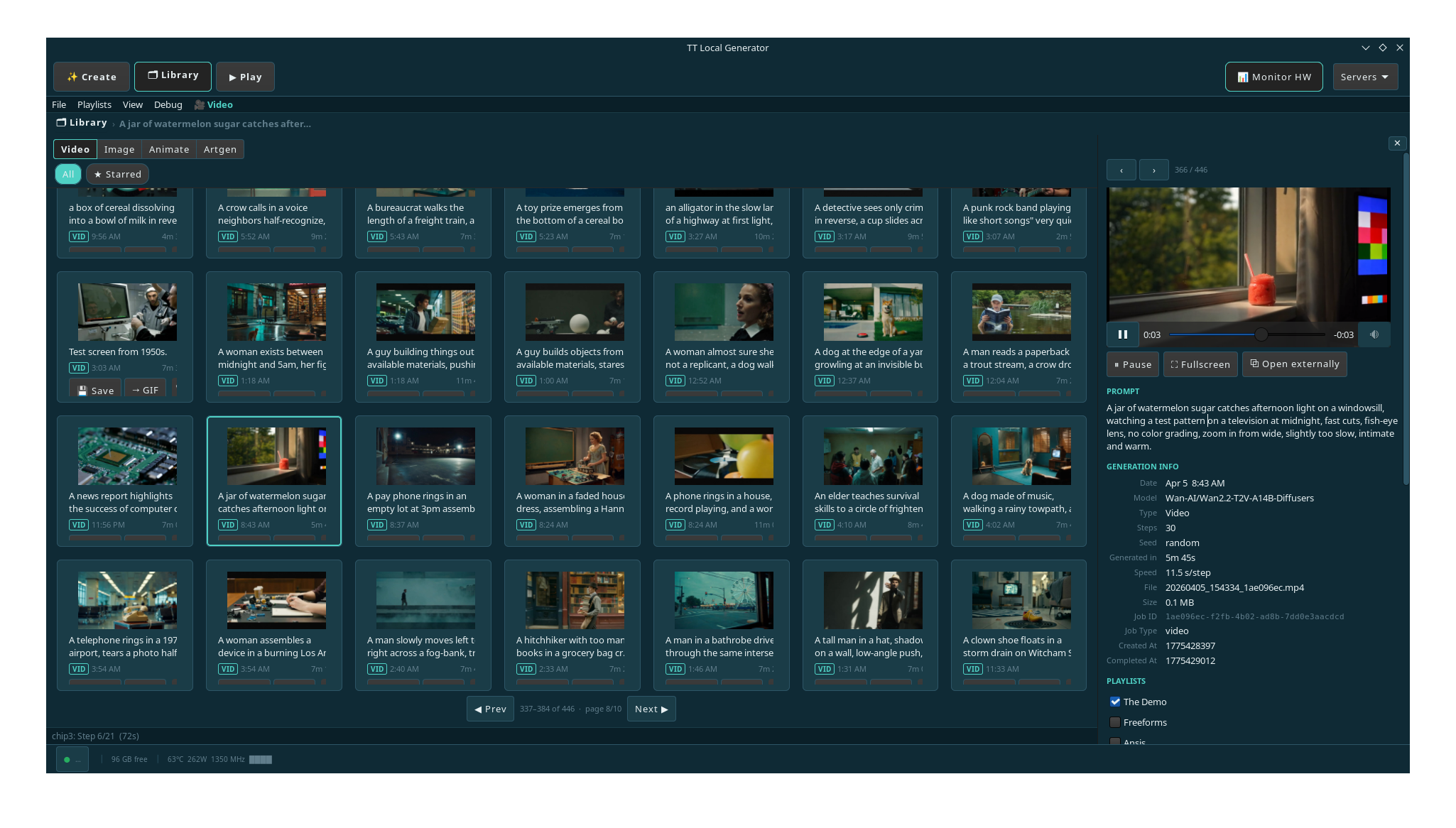
GTK4 desktop app for generating video, images, and generative art locally on Tenstorrent hardware — Wan2.2 text-to-video and character animation, SkyReels-V2, Mochi-1, FLUX.1 text-to-image, and AnimateDiff, plus a three-tier prompt generator (algorithmic, Markov, Qwen3-0.6B) to inspire them. Installs from the Tenstorrent PPA; model weights ship as separate tt-model-* packages, and an MCP server exposes every generator as a tool to Claude Code and other clients.
Command-line utility that runs a high power-consumption workload on Tenstorrent devices — used for chip testing, burn-in, and validating a system's power delivery and cooling under sustained load.
# Changelog

All notable changes to this project will be documented in this file.

The format is based on [Keep a Changelog](https://keepachangelog.com/en/1.0.0/),
and this project adheres to [Semantic Versioning](https://semver.org/spec/v2.0.0.html).

## 0.2.2 - 31/07/2024

### Added
- Added glx reset support
- Threaded start and end of burnin to increase burnin speed
- Added prints to indicate which chip we are currently running on
- Added support for bh harvesting

## 0.2.1 - 16/01/2024

### Bug fix
- Fix for https://github.com/tenstorrent/tt-burnin/issues/6
- BH reports asic temperature as a signed 16_16 int unlike GS and WH
- Added missing support to report BH asic temperatre

## 0.2.0 - 29/10/2024

### Added
- BH burnin support

## 0.1.1 - 14/05/2024

### Updated

- Bumped luwen (0.3.8) and tt_tools_common (1.4.3) lib versions

## 0.1.0 - 04/04/2024

First release of opensource tt-burnin

### Added
- GS and WH burnin support
burn-instress-testpowerhardware-validation
Works on
wormholeblackhole
tt-CableGen
official
JavaScript · Apache-2.0 · 4⭐ ·
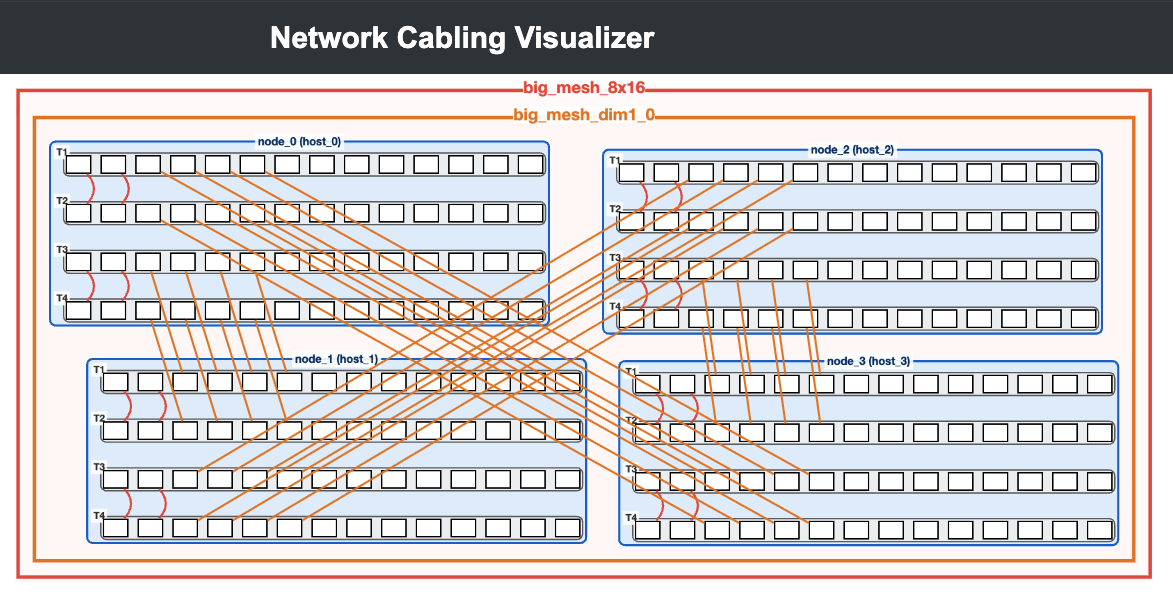
Network cabling visualizer for Tenstorrent scale-out deployments: describe a target topology and it generates and renders how to physically cable multiple Wormhole or Blackhole systems together. Works in a physical-deployment mode with racking information and a logical-hierarchy mode for clustering/pod groupings, with topology import/export and a Docker deployment path.
Generates short, temporally coherent animated GIFs using the AnimateDiff model on Tenstorrent hardware. Phase 1 runs the correct SD 1.4 + MotionAdapter architecture on CPU; Phase 2 accelerates spatial denoising on Blackhole using the TTNN UNet. Produces vibrant 8-frame animations in ~15 s/frame on a P300C.
A whole LLM inference stack you can read end to end: gpt-oss-20b and gpt-oss-120b running on Blackhole with **no TTNN, no TT-Metalium, no vLLM** — the same MXFP4 GGUF file an Ollama user already has, loaded straight into hand-written C++20 BRISC firmware over the kernel driver. Attention, expert matvecs, RMSNorm and SwiGLU all run inside the Tensix tiles, with four-chip runs (120b on a QuietBox 2) exchanging activations over direct PCIe peer-to-peer DMA rather than through the host. Around it sits a self-contained laboratory: a Python-shaped DSL that compiles to SFPU vector kernels, a bit-exact host-side device proxy that simulator and silicon must match logit-for-logit (`--check`), CPU reference inference, `--profile` per-stage device cycles, tensor dumps, and a `ttsim` path so kernel work needs no hardware at all. Roughly 12,000 lines of C++ from prompt to Tensix instruction; the README reports 3.83 ms of device time per 20b token across 32 tiles. One sequence, greedy decoding, no serving endpoint — this is a laboratory for understanding the silicon, not a serving framework, and it takes exclusive ownership of its chips.
Standalone library of reusable TTNN transformer building blocks (MLP, attention, RMSNorm, RoPE, embedding, LM head, sampling), a model-neutral LLM runtime, and HF-style `from_pretrained()` → `generate()` model implementations, extracted from tt-metal into its own repo. Ships Llama 3.x (1B–70B), Qwen2/2.5/3, Mistral 7B, Phi-4, and DeepSeek R1 Distill across N150, N300, T3K, and Blackhole P150/P150x4. It's a developer preview: every model is marked experimental and pinned to `ttnn==0.77.0`.
# Changelog

All notable changes to this project will be documented here.

## 2.0.0.dev0

- Establish `tt-transformers` as the standalone package for TTTv2 modules,
  runtime components, sampling, and twelve experimental model families.
- Add reproducible package builds and CPython 3.10/3.12 host validation.
- Add serialized Wormhole and Blackhole hardware qualification policy.
- Require `ttnn==0.79.0`. Trace capture now acknowledges its allocations to
  ttnn's trace allocation tracker (tenstorrent/tt-metal#53735).
- Rename the warmup override `trace_prefill_warmup_seq_lens` to
  `prefill_warmup_seq_lens`.
- Remove the TTTv1 sampler surface from `tt_transformers.sampling`
  (`generator`, `tt_sampling`, `tt_penalties`). Use
  `tt_transformers.modules.sampling`.
- With any trace mode, a prefill bucket that has no captured trace is served
  eager instead of failing. The first eager request per bucket logs one
  warning, and the load logs which buckets are traced.
- A traced configuration whose warmup lengths leave a servable prefill bucket
  uncompiled is refused at load with a `ValueError`.
- A `max_seq_len` that isn't a prefill bucket boundary now warms the bucket it
  pads to.
- Warmup compiles the prefix-cached variant of every prefill bucket a cached
  prompt can reach, including the top one. A configuration whose `max_seq_len`
  is itself the top bucket gains one such case per sampling path, captured as a
  trace where that bucket is traced; the Llama-3.1-8B N300 trace region grows
  to 70 MB for it.
  The Qwen3-32B T3K trace region grows from 120 MB to 150 MB: its batch-32
  cases gain three prefix-cached 1024 traces and need up to 125 MB.
- Default KV-cache sizing leaves room for the decode page table. A paged KV
  cache narrower than the decode page table is refused at load with a
  `ValueError`, instead of failing on the first decode step.
- On-device greedy sampling breaks an exact logit tie by the lowest token id,
  as host argmax does. Before, the pick depended on the batch slot and could
  vary between runs.

This is a developer preview. No model is promoted beyond the support status in
`SUPPORT.md` and its example manifest.
Official setup and onboarding guide for the TT-QuietBox 2 — a compact, liquid-cooled AI workstation with four Blackhole accelerators, an AMD Ryzen CPU, 256GB RAM, and 4TB NVMe. Covers hardware specs, first-boot setup, and hands-on learning paths for running pre-loaded models like Qwen3-32B and serving text, image, video, and speech models via tt-inference-server.
Official documentation hub for running Tenstorrent accelerators on Kubernetes. Centers on tt-operator (the umbrella Helm chart) and covers Node Feature Discovery, kernel-mode driver (tt-kmd) management, firmware flashing, Prometheus telemetry, Fabric Manager topology resolution, Dynamic Resource Allocation, and multi-node scheduling via JobSet and PMIx.
Browser-based cloud console for exploring AI on Tenstorrent hardware. Run LLM inference, image and video generation, and browse the supported model catalog in-browser — backed by Tenstorrent accelerators. Cloud hardware access and advanced workflows (deployments, agents) available in staged rollout.
Tensix GEMM performance estimator and visualizer. A React app that models matrix-multiplication workloads on a Tensix core, estimates the resulting performance, and shows how the work maps onto the hardware — useful for reasoning about a matmul's shape and fidelity choices before writing the kernel.
Tenstorrent's fork of QEMU that provides the full-system emulation layer behind ttsim. Models the RISC-V cores and system devices of Wormhole and Blackhole so TT-Metalium workloads can boot and run without physical silicon.
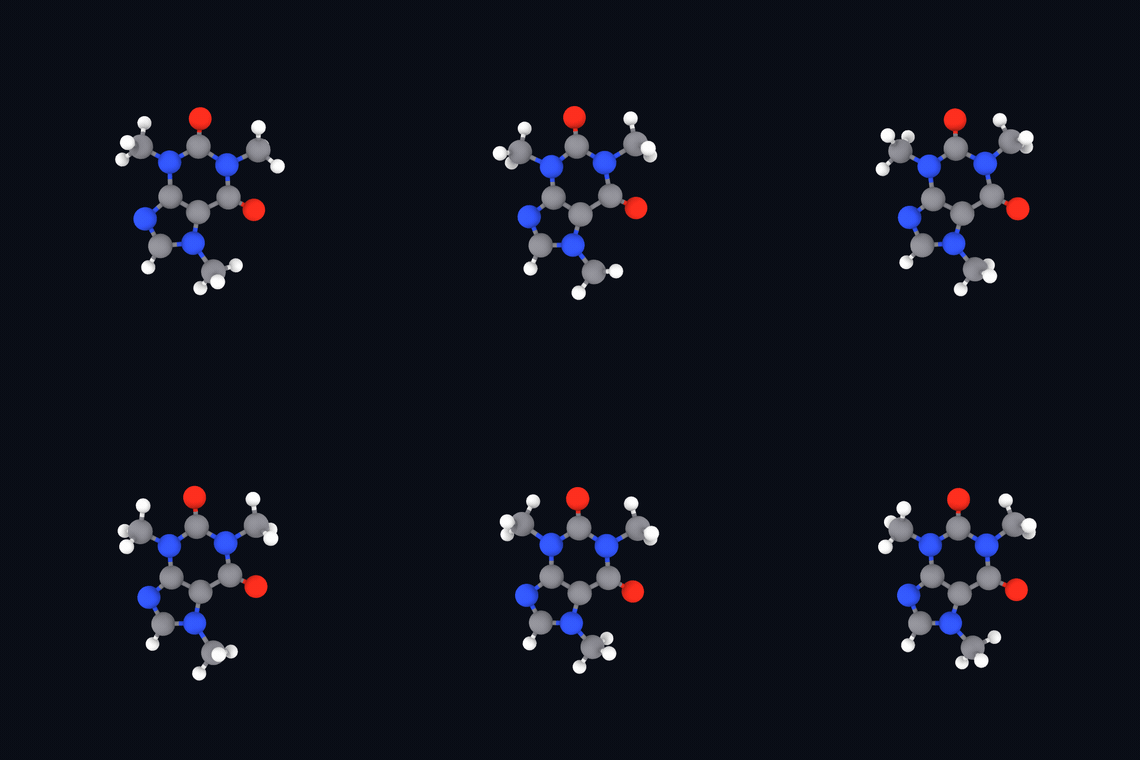
Boltz-2 biomolecular model for drug discovery on Tenstorrent Blackhole. Supports single-card and multi-card configurations — QuietBox (4×) and Galaxy (32×). Approaches physics-based FEP accuracy at 1000× the speed.
# Changelog

All notable changes to TT-Bio are recorded here. Versioning is [SemVer](https://semver.org);
releases are cut from a commit that has passed the on-hardware test suite (see `RELEASING.md`).

## [Unreleased]

### Fixed

- **A BindCraft 2 out-of-memory refusal says how much of the card the failing trajectory
  allocated.** It used to call everything allocated on the card "held by this fold", and in one
  reported campaign three quarters of that had been held before the trajectory started. A
  campaign now reads the card at each trajectory boundary and the refusal prints both parts; when
  most of it was inherited it points at `resume=true` instead of at the fold's size (#19).

- **A process that used a Tenstorrent card exits on its own, with its own status.** A BindCraft 2
  campaign could finish its work and then exit 139, or hang with SIGTERM ignored after an
  out-of-memory refusal, in teardown after Python was done. tt-bio now ends the process once it
  has closed the card, with the status the program chose, before the C++ destructors of tt-metal
  and XLA run. The stderr filter that tt-bio forked at import is gone; the nanobind leak report it
  dropped is still dropped, and `--debug` (or `TT_BIO_DEBUG_STDERR=1`) shows it (#20).

## [0.13.0] - 2026-10-08

Your own objective and your own outputs, on the models tt-bio already ships. BindCraft 2's design
loss takes terms you write, every structure model writes its full confidence matrices, and a fold
can carry an output head of your own.

### Added

- **A BindCraft 2 loss you can change.** `bindcraft2.loss_terms` adds a term of your own,
  reweights or switches off any of BindCraft 2's 37, or replaces what one computes, from ordinary
  Python with the settings file untouched. A term reaches the gradient, the mutation and
  acceptance scoring and `losses.csv` alike, on the card and on BindCraft 2's own JAX trunk.
  `bindcraft2.check_gradient` grades a term against float64 central differences, and a term whose
  gradient is silently zero is refused by name before a campaign spends on it. With no custom term
  the design loop is unchanged. Worked example: `examples/bindcraft2_custom_loss.py`; reference:
  [`docs/bindcraft2.md`](docs/bindcraft2.md#custom-loss).
- **Confidence exports for every structure model.** `--write_pae` now writes `<name>_pae.npz` with
  the full PAE matrix, the PDE matrix and contact probabilities from the model's own distogram,
  plus a JSON sidecar naming each array's shape and units, for Boltz-2, OpenDDE, OpenFold3,
  OpenBind-0, ESMFold-2, RF3, Protenix and AF2-IG. ESMFold-2 and AF2-IG compute a full PAE matrix
  for the first time, and OpenFold3, OpenBind-0, RF3 and AF2-IG report the chain-pair ipTM matrix
  in `results.json`. `--contact_cutoff` sets the contact distance. Protenix has no contact
  probabilities and AF2-IG no PDE, and the sidecar says so.
  [`docs/confidence-outputs.md`](docs/confidence-outputs.md).
- **An extension surface.** `tt-bio predict --
FlashAttention-style attention kernel implemented entirely in on-chip SRAM on the Tenstorrent Grayskull chip using TT-Metalium. Pioneering work in low-level attention on TT hardware.
Meta's UMA interatomic potential running on Tenstorrent Blackhole — energy, forces, and stress for molecules and periodic materials behind an ASE calculator. Its per-edge Wigner rotation runs as a custom tt-metal kernel for a highest-performance uma-s build.
# Changelog

All notable changes to TT-Atom are recorded here. Versioning is [SemVer](https://semver.org);
releases are cut only from a commit that has passed the on-hardware release gate — accuracy
parity, no OOM across the supported size range, no perf or UX regression, and a clean install
smoke (see `RELEASING.md`).

## [Unreleased]

Behaviour changes are all in the knobs and the caches, not in the models: every numeric path is
byte-identical to 0.3.0.

### Fixed
- The release gate's perf leg no longer decides by luck. It took one measurement per model against
  a fixed 15% threshold, and on a p150a the throughput spread between runs reaches that threshold
  on its own: in the gate run that closed this entry, `uma-s-1-omol-batch` drew 88.9, 104.4 and
  104.8 sys/s, and the first of those alone is a 20% shortfall against the baseline. The leg now
  waits for every other process to let go of a card and gates the median of three independent
  runs, printing all three. With no quiet window it measures anyway and reports a shortfall as
  `GAP`, since a contended run is not evidence of a regression.
- `benchmarks/_harness.host_quiet()` reported the host busy forever. It grepped process command
  lines for `tt_bio`, which matches any agent whose own arguments merely mention it; it asks the
  kernel who holds a `/dev/tenstorrent` node now. The three benchmarks that wait for a quiet host
  used to burn their full 40-minute budget and stop without measuring.
- The edge-bucketing speedup in the README and `docs/orb-port.md` is re-measured and now names the
  environment it was taken in. It said 1.4x cold wall-clock on a 20-system screening stream; two
  draws on the pinned tt-metal source build give **1.11x and 1.14x** (235.1 / 236.5 s unbucketed
  against 210.9 / 207.6 s bucketed). What bucketing saves is compiles, and that is unchanged and
  exact: 20 distinct edge shapes collapse to 7 buckets and 2350 fewer kernel files are built,
  identical to the file across both draws. The wall-clock ratio fell because a compile costs about
  half what it did in whatever environment produced the earlier number — which that log does not
  record, so the three subprocess benchmarks now stamp `ttnn_version` next to `git_sha`.
- `benchmarks/_harness.sandbox_env` resolves the sandbox `$HOME`. A relative `--workdir` reached
  the child as a relative `$HOME`, and tt-metal resolves that against the child's own working
  directory: it died deep in the JIT build with "Failed to open compile failure log file" and a
  path that reads as correct. `bench_compile_pain.py` also defaulted to `--card 3`, a card that
  does not exist on the host this repo is routed to.
- `TT_ATOM_SCATTER_THRESHOLD` is documented. It is the node count above which UMA's dense one-hot
  scatter gives way to the linear path, and therefore what bounds DRAM on a large cell, but it
  appeared in no doc.
- The release gate reads `OVERALL: PASS` again. Both Orb perf rows were seeded on a stock `ttnn`
  0.68.
A growing collection of models that use tt-lang for some or all of their implementation. Reference implementations for bringing modern models to the tt-lang DSL.
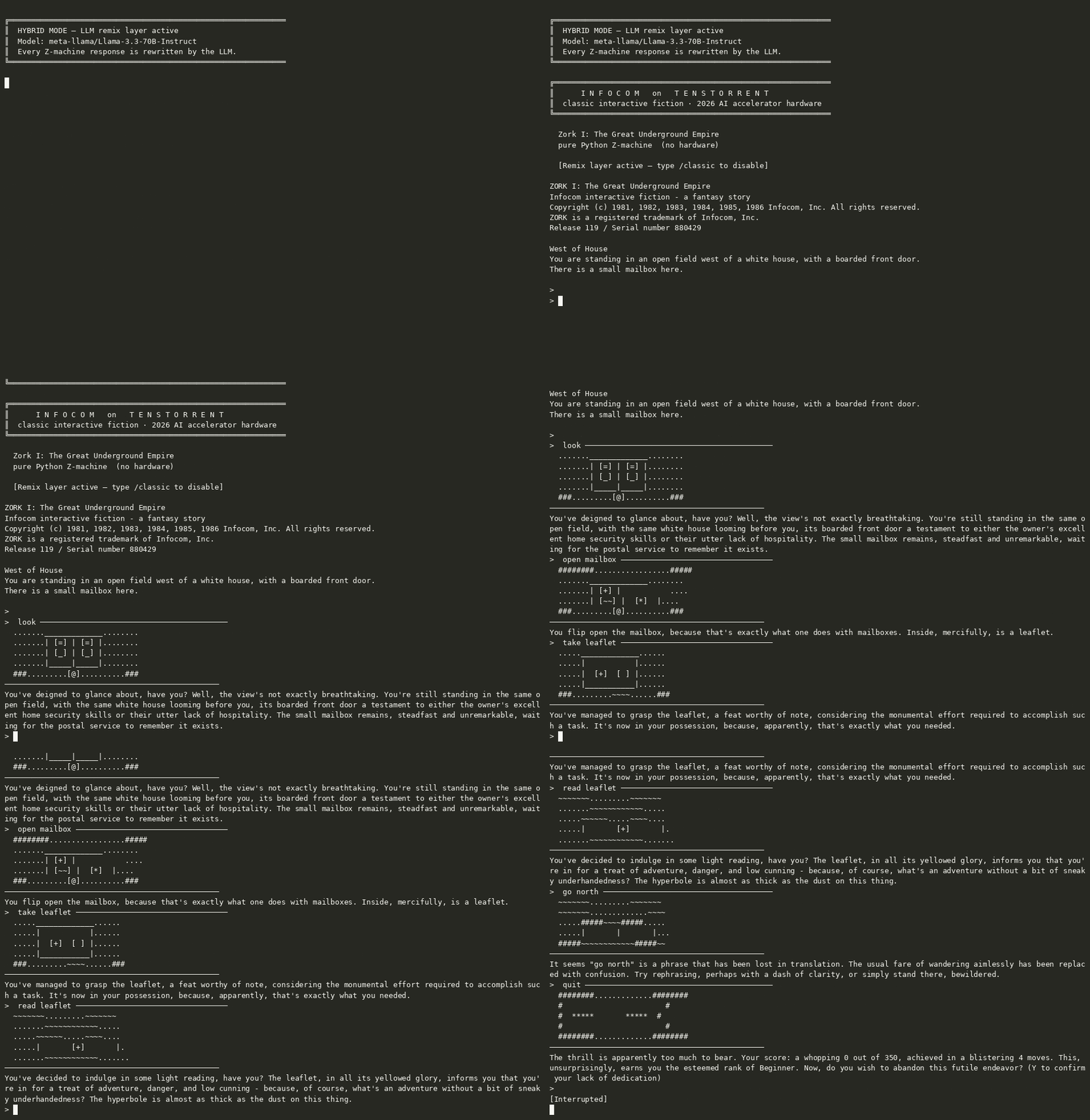
A Tenstorrent fork of Infocom's Zork I (and more!), running a Z-machine interpreter at least four different ways on TT hardware. The most fun you can have with an AI accelerator.
Discover, load, and benchmark models with a GUI and TUI for tt-inference-server. Makes exploring available models on Tenstorrent hardware as easy as browsing a catalog.
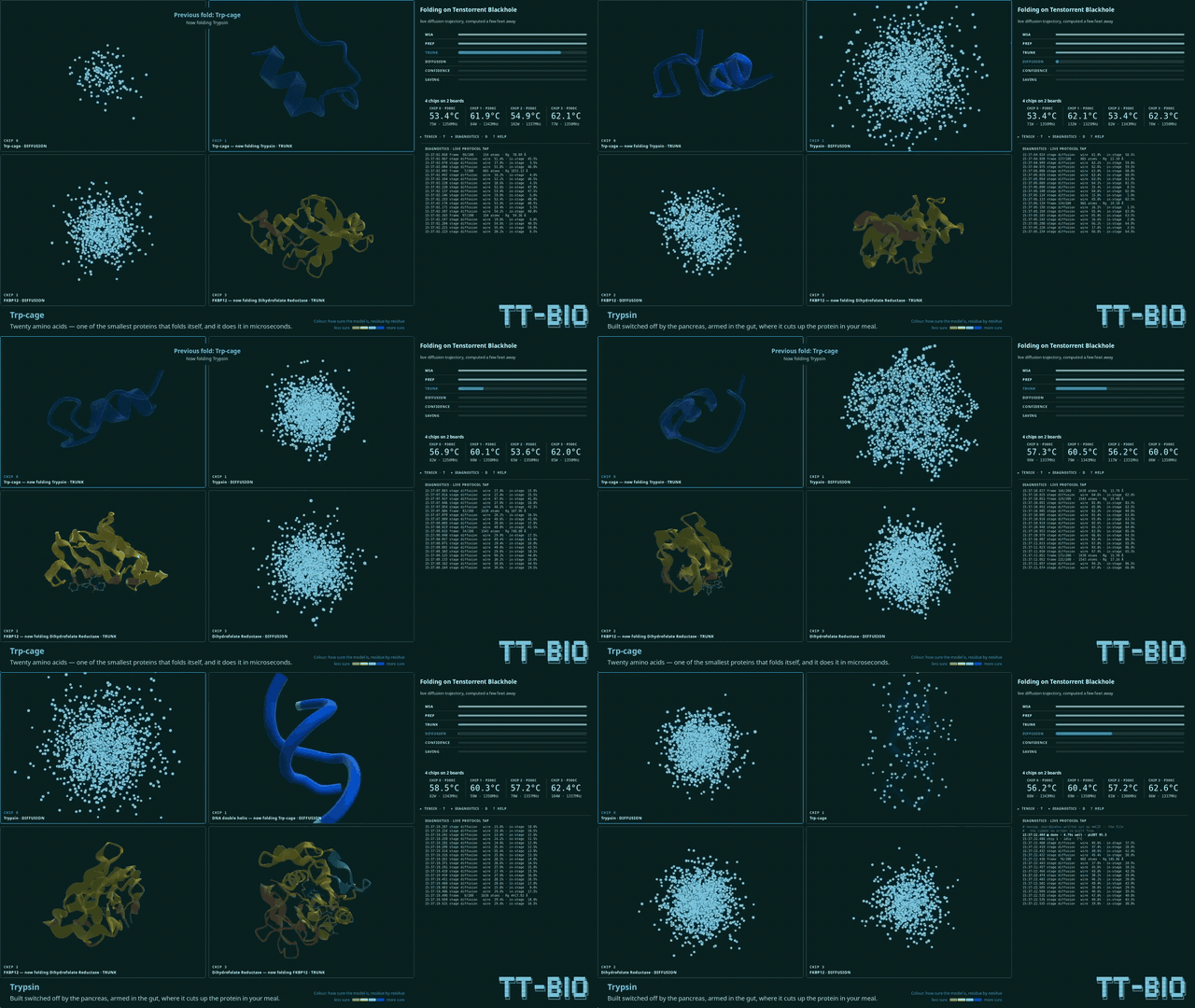
A turnkey conference-booth demo for tt-bio: watch a protein condense out of noise into its folded structure in real time, computed on the Blackhole chips a few feet away. Native GTK4 and OpenGL, with a cartoon renderer, live per-residue confidence colouring, a Tensix core grid, and a 2×2 quad view running four independent folds on four chips at once.
A Tenstorrent-powered claw machine that rewards players with real prizes. The QuietBox 2 runs local AI inference to act as an agent controlling the claw hardware — the OpenClaw AI assistant lesson builds directly on this project.
Three agentic projects running fully on-device: local AI agents on QuietBox 2, a coding assistant powered by Aider against a local inference server, and the OpenClaw AI assistant on QuietBox 2. No cloud APIs — all inference runs on TT hardware.
DFlash: Block Diffusion for Flash Speculative Decoding on Tenstorrent hardware using tt-lang. Combines block diffusion with speculative decoding for faster inference.
Serves AlexWortega/openjev, a Qwen3.5-4B NLI cross-encoder, as a vLLM pooling model on four Blackhole chips with 4-way tensor parallelism. The repo holds tt-metal and vllm-tt-plugin patches (classifier head, pooled prefill traces, pooling support), a tt-inference-server catalog entry, eval scripts and results: MNLI-500 accuracy 0.892 on TT vs 0.896 on CPU bf16, and about 32 ms per input up to 128 tokens. Includes a zero-shot Flappy Bird demo driven by /classify calls, with videos and a browser replay viewer. Weights are not duplicated; they load from the upstream checkpoint.
A pip-installable library whose public API mirrors Hugging Face transformers' `Auto*` loaders, with model recipes that replace supported modules with TTNN implementations and fall back to CPU `nn.Module`s for the rest; the only added line is `set_device(model, mesh)`. Verified recipes include Ling-mini-2.0 on T3K, ResNet-50, Gemma 4 E2B/E4B and Qwen3-VL-2B on N150, with `compatibility.report(model)` showing which modules actually ran on device. `ttnn` must be built from source at the pinned tt-metal commit. It is the standalone packaging of the framework that started in tt-metal's `models/experimental/tt_symbiote`.
Three lesson-projects covering on-device video synthesis: frame-by-frame diffusion with tt-local-generator, native AnimateDiff video animation, and video generation on QuietBox 2. All run entirely on TT hardware with no cloud dependency.
Eric Zietlow's blog covering Tenstorrent hardware, Metalium programming, and AI topics, sharing practical experience with Blackhole and the broader TT ecosystem from our developer relations team.
# Changelog

All notable changes to tt-forge-compiletron are documented here.

## [Unreleased]

### Added
- `docs/kv-cache-bench.md` — teaching companion for the StaticCache KV cache
  benchmark, explaining the two-graph pattern and why static shapes matter

---

## [1.6.0] — 2026-06-30

### Added
- **StaticCache KV cache decode benchmarking** — `bench_decode.py` now compiles
  a second forge graph for the decode step using `transformers.StaticCache`.
  The StaticCache is embedded in `KVDecodeWrapper` as a submodule so forge
  traces K/V tensors as model state and emits `FillCache`/`UpdateCache` ops.
  Falls back to full-recompute for models that don't support `cache_position`.
- `_try_kv_decode()` function — detects model dtype to avoid bfloat16/float32
  mismatches, resolves tokenizer from loader or AutoTokenizer, pre-fills cache
  on CPU before forge compilation.
- Bestiary `decode_note` field now records the method used per model
  ("StaticCache KV cache" vs "no KV cache — full recompute per step").

### Changed
- Decode results updated for all 5 stages — GPT-2 2.30→5.52 tok/s, OPT
  3.98→5.05 tok/s, Phi-2 1.48 tok/s (new), Falcon 3.30 tok/s (new),
  LLaMA-LoRA 2.86 tok/s (new), Gemma-LoRA 2.40 tok/s (new), and more.

---

## [1.5.0] — 2026-06-30

### Added
- **`scripts/bench_decode.py`** — dedicated LLM decode benchmark measuring
  TTFT, prefill tok/s, and decode tok/s for all compiled causal LMs.
  Subprocess isolation + tt-smi health check prevent hardware lockups.
- **Leaderboard columns** — TTFT, Prefill tok/s, Decode tok/s, Params (M)
  replace the old Infer p50 / Throughput columns in `docs/leaderboard.html`.
- 5 benchmark stages: Stage 1 (GPT-2, OPT), Stage 2 (Phi-2, BLOOM, CodeGen),
  Stage 3 (Falcon, Allam, LLaMA-LoRA, Gemma-LoRA), Stage 4 (Qwen 2.5,
  Phi-1 LoRA), Stage 5 (DeepCogito, DeepSeek Coder, frontier models).
- `params_m` field added to all benchmarked bestiary entries.
- `hf:` loader prefix for frontier HuggingFace models loaded without a
  tt-forge-models seed loader.

### Changed
- Bestiary `throughput_unit` relabeled from generic `tok/s` → `prefill_tok/s`
  for all 54 causal LM entries to prevent confusion with decode throughput.

---

## [1.4.0] — 2026-06-29

### Added
- **`scripts/install.sh`** — turn-key smart installer: hardware pre-check,
  hugepages, disk space, forge venv, XLA venv, mesh descriptor probe,
  tt-forge-models clone, stale-shm cleanup. Outputs color-coded summary table.
- **RAM/DRAM budget calculator** — skips models whose weights exceed available
  system RAM + per-chip DRAM; prevents OOM crashes at load time.
- **`scripts/setup-venvs.sh`** — minimal venv setup script for clean Ubuntu
  24.04 installs on Tenstorrent Blackhole hardware.
- Self-contained patches directory — tt-forge-models fixes applied at
  expedition startup without modifying upstream.
- `--ephemeral` / `--evict-failures` flags — evict HF weight cache after
  each model to reclaim disk space on small-storage machines.

### Changed
tt-forgemodelsdemocompilation
Image Classification with TT-Forge
affiliated
by
·
End-to-end image classification project using TT-Forge — compile and run a PyTorch classification model on Tenstorrent hardware with no kernel authoring required.
Hardware topology visualizer for Tenstorrent chips — from individual chip to full cluster. Interactive JavaScript visualization of Tensix core layout and NoC connections.
# Changelog

All notable changes to tensix-viz are documented here.

## [1.3.2] - 2026-09-28

### Fixed

- **Cluster views no longer collapse to their caption's width**
  (`src/cluster.js`). Cluster tiles are empty divs with no width of their own,
  so a shrink-to-fit parent sized the whole widget to its one-line spec text —
  Galaxy SC's 128 chips rendered as 2.7px dots. The tile grid now gets a
  preferred width from its column count (32px tiles, or 10px dots above 64
  chips) and `max-width: 100%`, so it still shrinks on phones.
- **Zoomed cluster breadcrumb no longer covers the spec caption**
  (`tensix-viz.css`). `.tv-cluster.tv-zoomed-in` reserves room at the top for
  the "Cluster › Server N" breadcrumb.

### Docs site (landing page)

- Hero and two-column sections now stack at 1120px instead of 900px. Between
  those widths the QB2 hero chips were squeezed to ~120px and the Memory code
  block hid up to ~140px of each line; the hero now gets full 340px chips there.
- Code blocks wrap at ≤800px instead of hiding most of each line in a sideways
  scroll box (the Quick-start block hid ~400px per line on a phone).
- Phones: tighter padding around the hero system (chips 85px → 119px at
  375px wide), and `kernel_dispatch` may wrap so the mode table fits.

## [1.3.1] - 2026-09-28

### Fixed

- **Chips in a card/system no longer come out at different sizes**
  (`src/card.js`, `src/chip.js`). `TensixViz` caps its drawing size to its
  parent's `clientWidth` once, at construction. `CardViz` builds chips one at a
  time into a flex row, so each chip measured the room its predecessors had
  left — on the docs hero, QB2's second chip in each card rendered at roughly
  half the size of the first. Card chips now pass the new
  `fitContainer: false` option and keep their full logical size; CSS fits them
  (`.tv-chip-wrapper { flex: 0 1 auto; min-width: 0 }`).
- **Shrunk canvases are no longer squished.** The inline `style.height = Hpx`
  overrode `.tv-chip-wrapper canvas { height: auto }`, so whenever
  `max-width: 100%` narrowed a canvas its height stayed put (aspect ratio 0.8
  instead of 1.42). Canvases now get `max-width: 100%`, `height: auto` and an
  explicit `aspect-ratio`, so they scale cleanly after construction too.
- `.tv-card`, `.tv-system`, `.tv-card-wrapper` and `.tv-cluster` can shrink to
  their container (`max-width: 100%` / `min-width: 0`).

### Docs site

- Hero and "chip anatomy" grids use `minmax(0, 1fr)` tracks; a bare `1fr`
  couldn't shrink below the Memory section's `<pre>`, which pushed the page
  sideways even on desktop.
- The mode reference table scrolls inside its own box on phones.
- Hero theme buttons are grouped with the canvas they theme (they were a stray
  third grid cell under the hero text).
- Examples: demo cards can shrink below their canvas's preferred width, page
  padding scales down on phones, and the theme toolbar wraps.

## [1.3.0] - 2026-09-24

### Added

- **`setActivity(value)` and `setProgress(value)`**
A project-agnostic toolkit for authoring demo recordings and draft posts from inside any project. Describe scenes in a small YAML manifest and it drives the terminal ballet — tmux, asciinema, VHS, ffmpeg and agg — into asciicast/GIF/MP4 footage plus a first-draft Markdown post pairing each directive with the reaction it caused. Rust orchestrator over bash capture primitives, with idle trimming, readiness gating, and a /tt-demo Claude skill that writes the manifest for you.
Cooperative chip leasing for Tenstorrent boxes, so several agents — Claude Code sessions, aider, shell scripts, cron jobs — can share one machine without corrupting each other's runs. A lease records who is using which chips and why; the kernel's view of the devices is the tiebreaker when the two disagree. Standard-library Python, board-grain leases by default, and it ships Claude Code skills that teach agents to lease before they run.
Interactive browser-based visualizer of the Tenstorrent Tensix grid architecture. Explore the NoC, core layout, and dataflow patterns without hardware — a great companion for learning kernel programming.
TT-Metalium implementation of Conway's Game of Life as a cookbook recipe. Each generation is a full parallel kernel dispatch over the grid — a clean introduction to stateful compute on Tensix cores.
Particle Life simulation on Tenstorrent hardware — an emergent-behavior N-body system where simple attraction/repulsion rules between species produce complex lifelike patterns. Cookbook recipe demonstrating parallel N-body compute on Tensix.
A university teaching lab for TT-Metalium kernel programming on a virtual Tenstorrent chip — one-click GitHub Codespace, no silicon and nothing installed locally. The primary track (labs 00-06) points tt-metal straight at libttsim via TT_METAL_SIMULATOR and walks from elementwise add through NoC multicast to multi-core and multicast matmul, backed by a source-level matmul guide. An optional advanced track (labs 10-16) boots an Ubuntu guest under ttsim-qemu, loads tt-kmd, surfaces /dev/tenstorrent/0, and runs tt-metal through the full PCIe path.
Seven-module computer science curriculum taught on real Tenstorrent hardware. Covers RISC-V architecture, memory hierarchy, parallel computing, networks and NoC, synchronization, abstraction layers, and computational complexity — all grounded in what is physically happening on the chip.
Eight-lesson series covering the full custom training workflow on TT hardware: dataset fundamentals, configuration patterns, fine-tuning, multi-device distributed training, experiment tracking, model architecture basics, and training from scratch.
Three hands-on TT-Metalium kernel recipes: a Mandelbrot fractal explorer, real-time audio signal processing pipeline, and custom image filter stack. Each recipe is a complete kernel project with full source in the lesson.
Exploring spectral element methods on the Tenstorrent RISC-V accelerator
affiliated
by
·
The growing availability of commodity RISC-V hardware has sparked interest in its use for High Performance Computing (HPC), with PCIe accelerator cards offering a practical near-term pathway to adoption. The Tenstorrent Wormhole is one example, with dedicated vector and matrix units across 128 Tensix cores, and is widely available. In this paper, we explore porting the AX kernel of Nekbone, a widely used HPC mini-application derived from the Gordon Bell Prize-winning Nek5000 spectral element solver, onto the Wormhole accelerator.
htop-style process monitor for GPUs and AI accelerators. Supports AMD, Apple, Huawei, Intel, NVIDIA, Qualcomm — and Tenstorrent. Real-time utilization, memory, and process info in a terminal UI.
Vendor-agnostic orchestration for training, inference, and agentic workloads across NVIDIA, AMD, TPU, and Tenstorrent on clouds, Kubernetes, and bare metal.
An open-source CUDA, HIP, and Triton compiler with no LLVM anywhere in the path. Takes the same sources you would hand to nvcc, ROCm, or Triton's JIT and emits AMD RDNA 2/3/4 binaries, NVIDIA PTX, Tenstorrent Metalium C++, native RV32IM, or plain x86-64 — so a Triton matmul can run on a laptop that has never seen a GPU. Also reads a deliberate subset of MLIR (`func.func` plus the `arith` dialect) and Fortran `do concurrent` kernels via LFortran. Formerly BarraCUDA; renamed to honour Kathleen Booth.
Booth — Changelog
=================

## Booth 0.6.0

### Runtime

- `kath run`, `kath build` and `kath doctor`, so one command builds a source
  and runs it on whatever device is there (Zane Hambly, 2026-09-14)

### Backends

- `--nvidia-cubin` writes a cubin the card will load, with no NVCC anywhere in
  the chain. All 67 of ggml-cuda's files now reach the IR
  (Zane Hambly, 2026-09-09)

### Frontend

- `constexpr` and `const` objects fold at every use, and anything the folder
  cannot evaluate refuses with E128 (Zane Hambly, 2026-09-03)

- class templates, specialisations, default template arguments and
  `enum class` parse, so 47 of ggml-cuda's 67 files reach the lowerer
  (Zane Hambly, 2026-09-04)

- the lowerer's tables no longer run out of room on a large translation unit,
  taking ggml-cuda's lowering errors from 774 to 210 (Zane Hambly, 2026-09-04)


## Booth 0.5.3

### Runtime

- #169: the runtime is split by where it runs, the `BC_ERR_*` codes no
  longer collide, and the examples and NVIDIA harness are built
  (Zane Hambly, 2026-08-23)


### Frontend

- variadic template parameter packs, several `.cu` files as separate
  translation units, `mma.sync` and `mfma` lowering, and an i1 that no
  longer strides by zero (Zane Hambly, 2026-09-03)

- `(a) + (b)` adds again; the parser treated any parenthesised identifier as a
  type name without asking whether it named one, so the left operand vanished
  into a cast with no diagnostic (Zane Hambly, 2026-09-03)

- the cast test is now the type name registry, so the registry has to be
  complete. Template type parameters, `using X = T` aliases and the type names
  sema resolves without a typedef (`size_t`, `uint32_t`, `float4` and the rest)
  all reach it. A compound literal through a typedef, `(pair){1, 2}`, parses
  for the first time, and `sizeof(name)` where the name is a type reads as a
  type rather than an expression (Zane Hambly, 2026-09-03)

- llama.cpp's ggml-cuda preprocesses, all 67 files; `#pragma once` is
  honoured, variadic and multi-line macro invocations expand, and an
  expansion too big for the output buffer is E053 rather than an
  unterminated buffer the lexer reads past (Zane Hambly, 2026-09-03)

- `kath --mlir` reads MLIR text, no LLVM in the path. Čertík's pure-C
  reader vendored under `src/mlir/vendor` (mlir 826b69c9, corec a160199d),
  reached only through `src/mlir/mlir_fe.c` (Zane Hambly, 2026-08-11)

- `src/mlir/lower.c` walks the parsed module into BIR: `func.func`, `return`,
  `arith.constant` and every arith binop, compare and conversion the reader
  classifies. From there it is the pipeline CUDA and Triton already use, and
  MLIR reaches all four backends. `--mlir --pp` reprints instead
  (Zane Hambly, 2026-08-11)

- an op outside the subset stops the lowering and names itself. Skipping it
  would leave a function that compiles and computes something else
  (Zane Hambly, 2026-08-11)

- five fixes to the vendored reader, all worth upstreaming, and four of them
A C++ reimplementation of the vLLM engine (continuous batching, paged KV cache, GGUF loading) with CUDA, CPU, Metal, Vulkan and ROCm backends plus an opt-in Tenstorrent backend under `src/vt/tenstorrent`. The TT backend is a thin adapter over TTNN and TT-Metalium built with `-DVLLM_CPP_TENSTORRENT=ON`, adding paged attention, Qwen3.5 gated-delta-net, trace capture and quant-preserving (`keepquant`) matmul paths. Status is correctness-first on Blackhole: OPT-125m passes a strict token-exact gate, Qwen3-0.6B has committed goldens with a full rerun pending, and 27B GGUF decode is in smoke-measurement stage.
A complete ML library and compiler in Rust — "from assembly to neural networks" — with a native Tenstorrent backend (src/backend/tenstorrent), autograd, custom kernels, multi-backend support, and Python bindings.
Minimal Python code to access and program the Tenstorrent Blackhole chip directly — George Hotz's exploration of TT hardware programmability with pointed commentary on the architecture.
An agent skill (SKILL.md) that teaches Claude Code, Codex, and the Agent SDK how to drive the console.tenstorrent.com inference API: OpenAI-compatible chat with DeepSeek-R1 and Qwen3, async image jobs, and Wan 2.2 text-to-video. Ships runnable curl examples and a mock-curl test harness; documentation is bilingual Korean/English.
OpenAI Triton compiler plugin for Tenstorrent hardware. Write Triton kernels and target Tensix cores — brings the Triton ML kernel ecosystem to TT devices.
Community-built Tenstorrent architecture simulator written in Python. Runs without hardware — useful for researchers and developers exploring the Tensix architecture offline.
IREE (Intermediate Representation Execution Environment) ML compiler ported to Tenstorrent AI accelerators. Brings the IREE compiler ecosystem to TT hardware.
An optimisation campaign for single-stream coding inference of `Qwen/Qwen3.8-27B` on two P150A cards linked by QSFP-DD (TP2), using DSpark speculative drafting, fused MLP and custom Tensix kernels, with CI workflows that replay each experiment on hardware and on `ttsim`. The author reports 118 committed tok/s at 4K context and 50 tok/s at 64K, and states plainly that the 200 tok/s target has not been reached. These are offline runtime tests, not a serving benchmark, and reproducing them depends on a Docker image that is not published to a registry. The docs include a Blackhole tuning playbook, a gotchas list and a record of fixes contributed upstream to tt-metal.
A web playground that runs real TTNN operations on the ttsim hardware simulator — no card required. Switch between Wormhole and Blackhole, run elementwise/activation/matmul ops or a small MLP, draw a digit and classify it with a trained MNIST net, then sweep parameters in 1D or 2D and read latency, throughput, and memory back as line charts, 3D surfaces, and heatmaps.
Tutorial on Tenstorrent hardware for HPC researchers from the RISC-V Testbed project at Edinburgh/EPCC. Covers Wormhole from an HPC parallel-computing perspective.
A TypeScript/Bun terminal client for console.tenstorrent.com. Opens a chat REPL across DeepSeek-R1, Qwen3-32B, Qwen3-VL, and Gemma, with slash commands that submit image, Wan 2.2 video, TTS, and STT jobs, poll them, and save the results under ./output. Reads its API key only from the TENSTORRENT_KEY environment variable — never from disk.
clpeak-style peak-performance benchmark for Tenstorrent devices using TT-Metalium. Measures theoretical peak throughput across operations — useful for hardware characterization.
Unofficial documentation for the Blackhole P100A / P150, assembled from reverse-engineering, disassembly, and hands-on experiment. Walks from a self-contained intro through chip architecture (NoC, Tensix tiles, RISC-V cores, L1, memory map), the 3-kernel matmul model, SFPI kernel writing, circular-buffer dataflow, the JIT build and dispatch pipeline, firmware boot sequence, and multi-host scaling. The author notes most pages were drafted by coding agents, with a `human/` folder that is explicitly hand-written.
Boot stock Linux cloud images on the SiFive X280 RISC-V cores inside Tenstorrent Blackhole AI accelerators. Per-card Rust daemon with virtio-mmio block/net/console and U-Boot/EFI support.
# Changelog

Notable changes per release. Format loosely follows
[Keep a Changelog](https://keepachangelog.com/en/1.1.0/);
this project does not yet promise SemVer compatibility on the RPC
wire format or library API surface (we're not 1.0).

## Unreleased

V2 virtio-dispatch redesign. The kick ring + completion ring + host-
side throttle that grew up around #184 are gone; in their place is a
per-(slot, queue) dirty bitmap in BRISC L1. The bitmap is level-
sensitive — guest QUEUE_NOTIFY storms coalesce into a single set
byte, so the dispatch path can't fall behind under any burst. Wire
incompatible with 0.9.0; `TENSIX_PROTOCOL_VERSION` bumped 4 → 5.

### Added

- **V2 dirty-bitmap dispatch** (`#187` / `#188` / `#189`). BRISC
  writes 1 to `CTRL_OFF_DIRTY[slot][queue]` on every guest
  QUEUE_NOTIFY; the daemon's `Dispatcher` clears the byte and
  dispatches each pass. Replaces V1's 2048-entry kick ring +
  daemon-side `consume_kick_ring_pass` consumer.
- **V2 processed-cursor table** at `CTRL_OFF_PROCESSED`. Daemon
  publishes `used.idx` after each successful dispatch so
  warm-resume reads cursors directly without re-probing guest
  DRAM.
- **`bhx_notify_events_total`, `bhx_dispatch_passes_total`,
  `bhx_dispatch_queues_drained`** Prometheus counters surface the
  new dispatch path. The burst regression test (`scripts/
  soak_virtio_burst.py`) asserts `dispatch_passes_total > 0` to
  confirm the workload reached the new path.
- **`scripts/soak_virtio_burst.py`** — multi-queue burst regression
  test. Sustains 16-job direct=1 fio randwrite + a tight
  `printf` loop to `/dev/console`, samples `/metrics` every 1 s,
  and verifies the daemon log contains zero
  `kick.*drop|rescue|throttle.*ENGAGE` matches.
- **`DaemonState.chip_reset_this_session`** flag — gates
  `maybe_opportunistic_reset_board` so 4-way parallel cold boots
  reset the chip exactly once, not once per L2CPU. Without this
  the second-and-later resets blip the chip while earlier-booted
  L2CPUs hold mmap pages, SIGBUSing their workers.
- **`Dispatcher` (was `KickPoller`)** with documented testability
  seam (`CtrlL1Access` trait); `drain_dirty_bitmap` is unit-tested
  against an in-memory L1 fake covering all five visit/clear
  semantics cases plus the address-formula pins.

### Changed

- **`KickPoller` → `Dispatcher`**, plus `kick_poller` → `dispatcher`
  field on `DaemonState`, `tensix-kick-poller` → `tensix-dispatcher`
  thread name, `[kick-poller]` → `[dispatcher]` log tag,
  `kicks_consumed` → `dispatches_total`,
  `last_kick_slot_queue` → `last_dispatch_slot_queue`. Pure
  rename; no behavior change. V1 vocabulary scrubbed throughout
  the codebase (firmware, daemon, scripts, docs).
- **`CTRL_SIZE` shrinks 36 KiB → 4 KiB**. V2 footprint is ~1.5 KiB;
  the rest is reserved for future fields.
- **Stats-page offsets repacked** — V1 `STATS_OFF_KICK_DROPS`,
  `STATS_OFF_COMPL_EVENTS`, `STATS_OFF_LAST_COMPL` retired with
  V1 (#190); deprecated PRECAP / BLINDCAP / POSTCAP slots dropp
A TTNN bring-up of `meta-models/Muse-Glimmer-30B` for batch-1 inference on a single Blackhole P150, with 2,048-token chunked prefill into a paged KV cache, the checkpoint's native DFlash drafter for speculative decoding, and an OpenAI-compatible server with streaming and tool calls. The author reports 119.99 AR tok/s at short context and 1,549 prompt tok/s on a 128,000-token prefill, and defines `ar_decode_tokens_per_second` narrowly: it excludes tokenization, prefill and tool parsing, and DFlash rate varies with draft acceptance. Weights are BFP8 for attention and BFP4 for MLPs, decode replays three captured device traces, and parity tests compare against the Transformers reference. Its custom `packed_kv_update` kernel was upstreamed into TTNN as `ttnn.experimental.indexed_fused_update_cache`.
A CLI wrapper that turns TT-Metal performance profiling into one command. Runs a pytest target under Tenstorrent's profiler, streams progress live, then parses the resulting CSV and reports total device kernel duration. Supports profiling by operation name (`ttperf add`) as well as by test path, and installs from PyPI.
# Changelog

All notable changes to this project will be documented in this file.

The format is based on [Keep a Changelog](https://keepachangelog.com/en/1.0.0/),
and this project adheres to [Semantic Versioning](https://semver.org/spec/v2.0.0.html).

## [0.1.6] - 2025-01-14

### Added
- **Memory Configuration Support**: New command-line options for tensor memory configuration
- `--memory-config CONFIG`: General option with choices `[dram, l1]`
- `--dram`: Shortcut flag for DRAM memory (default)
- `--l1`: Shortcut flag for L1 memory
- Memory configuration extraction from CSV profiler output
- Memory config display in test result summaries

### Changed
- **Default tensor shape reduced from `[1, 1, 1024, 1024]` to `[1, 1, 32, 32]` for better performance**
- Enhanced `create_test_tensor()` function to accept memory_config parameter
- Updated all `ttnn.from_torch()` calls to use memory_config parameter
- Improved CSV extraction to read memory configuration from profiler output
- Enhanced debug output to show memory configuration

### Technical
- Added `validate_memory_config()` function with alias support
- Extended environment variable system with `TTPERF_CUSTOM_MEMORY_CONFIG`
- Updated operation_configs.json to include memory_config field
- Enhanced test file configuration parsing to handle memory settings
- Improved result reporting to include memory configuration details

## [0.1.4] - 2025-01-14

### Changed
- **Major Improvement**: Configuration extraction now reads from CSV profiler output instead of parsing text with regex
- Replaced 50+ complex regex patterns with structured CSV data parsing
- Enhanced `extract_test_config_and_status()` function to prioritize CSV data over text parsing
- Added new `extract_config_from_csv()` function for reliable configuration extraction

### Fixed
- More accurate shape, dtype, and layout detection from profiler results
- Improved reliability of configuration reporting in test summaries
- Better handling of tensor dimension parsing (e.g., "32[32]" format)

### Technical
- CSV-based extraction provides structured, consistent data vs. unreliable text parsing
- Maintains backward compatibility with text parsing as fallback
- Cleaner, more maintainable codebase with reduced complexity

## [0.1.0] - 2025-07-14

### Added
- Initial release of ttperf CLI tool
- Support for profiling TT-Metal tests with pytest
- Automatic CSV path extraction from profiler output
- Device kernel duration calculation
- Real-time output streaming
- Flexible command-line argument parsing
- Support for named profiles
- Comprehensive error handling

### Features
- Simple CLI interface: `ttperf [name] [pytest] <test_path>`
- Automatic detection of test files and paths
- Integration with TT-Metal profiler tools
- CSV parsing for performance metrics
- Real-time progress monitoring

### Dependencies
- pandas for CSV processing
- Python 3.7+ support
- TT-Metal development environment

## [Unreleased]

### Planned
- Enhanced error messages

##
High-level parallel programming framework for Tenstorrent accelerators, abstracting TT-Metal into a research-oriented programming model for parallel computation.
Direct TT-Metal bringup of modern open-weight LLMs on Blackhole P150 — hand-written compute graphs with no PJRT and no JAX. Covers Qwen3.6-27B, Qwen3.6-35B-A3B MoE, Gemma 4 12B, and Nemotron-3 Nano 30B-A3B, plus a zoo of single-chip Llama / Qwen2.5 / SmolLM ports, backed by custom fused `owned_*` kernels, a continuous-batching engine, an OpenAI-compatible HTTP server, and a wiki documenting each design decision.
ttas is a hacker-friendly assembler/disassembler for Tensix on Wormhole. It turns assembly into the exact 32-bit words the hardware runs, and turns binaries back into readable instructions using the same shared instruction table.
Comprehensive tutorials for the Tenstorrent software stack in Korean. Jupyter notebooks covering the full developer path from hardware setup to model inference.
A GGML-formatted rotary positional embedding (RoPE) implementation for Tenstorrent hardware — one of the operator building blocks behind the community effort to give llama.cpp a Metalium backend.
Master's thesis implementing and benchmarking five allreduce algorithms (Swing, Recursive Doubling, Bandwidth Optimal, Latency Optimal, Shared Memory) on the Wormhole n150. Bandwidth Optimal achieved best performance, approaching within 2× of theoretical optimal.
Parameter-efficient fine-tuning — LoRA, rsLoRA, LoRA+, DoRA, and IA3 — on a single Blackhole P150a, behind a Hugging Face/PEFT-style trainer API. Ships as a self-contained Linux wheel bundling the TT-XLA/PJRT plugin, TTNN, and TT-Metal user-space libraries, so no source checkout, Docker, or PYTHONPATH setup is required. Includes a static planner that reports memory admission before you compile, deterministic checkpoint/resume, and standard PEFT adapter export.
Rust crate that exposes the TT-Metal host API through a C++ bridge via cxx.rs — covering device management, program/kernel creation (from source file or inline string), circular buffers, semaphores, runtime arguments, sharded buffers, and MeshDevice workflows, with hardware-backed integration tests.
A minimal Windows KMDF driver that stops a Blackhole PCIe card's fan running at 100% on Windows hosts, where no in-box driver exists. On `D0Entry` it maps BAR0 (ported from `blackhole_init()` in tt-kmd), programs a kernel TLB window to the ARC NOC node, and sends the `ASIC_STATE0` (0xA0) ARC message that hands fan control to the on-die firmware; it also parses the telemetry table for debug output. It has no compute path and no user-mode interface. Confirmed on p100a and expected to work on p150a/p150b; builds with Visual Studio and the WDK and needs test signing to install.
A standalone tt-metal demo and test bench for the RWKV-7 (WKV7) state recurrence on Wormhole, built with a GGML backend in mind. Two compute kernels cover the domain: a chunked-parallel DPLR matmul path for any sequence length with on-chip chunk carry, and a sequential per-token decode path for L <= 32 that is faster for large-batch token generation. The host runner validates both against a CPU oracle by PCC/NMSE and benchmarks them over a sequence/batch grid.
A correctness-first bring-up of Kimi-Linear-48B-A3B on four n300 cards (8 Wormhole chips). Each hot layer type (KDA, MoE, MLA) is one fused program built from Python through `ttnn.generic_op` and a `ProgramDescriptor`, with no tt-metal fork or C++ rebuild. Per-layer gates check each kernel against an fp32 torch oracle before a full load. Decode went from 1.44 tok/s eager to 13.5 tok/s at 16K context once it moved to paged flash-MLA on the compressed latent. The author notes that chunked prefill is 28x faster but wrong, so it is disabled. `FINDINGS.md` lists 15 faults, three of them silent, and how each was found.
A Bazel-built PJRT plugin (libtt.so) providing an XLA backend for Tenstorrent devices. Bundles the tt-xla PJRT implementation with tt-mlir and tt-metal into a single shared object so JAX code runs on Tenstorrent hardware, with patches so sglang-jax works out of the box.
A translucent, undecorated desktop widget showing live per-chip telemetry for Tenstorrent accelerators: temperature and power sparklines against the card's thermal and TDP limits, AI clock, voltage, current, DRAM channel training and ECC error counts, PCIe link generation/width, and board identity. Reads hardware directly through luwen over /dev/tenstorrent — no Python, no tt-smi subprocess, and no root.
A compatibility guardrail that continuously monitors whether [tt-metal](https://github.com/tenstorrent/tt-metal) and the official [tt-installer](https://github.com/tenstorrent/tt-installer) build successfully on community Linux distributions that are not part of Tenstorrent's official CI.
3D Gaussian Splatting rewritten to run on the matrix engine: a polynomial splat and order-independent weighted-sum blending replace exp and depth-sorted alpha, so the pipeline becomes GEMM → activation → GEMM. Renderer + trainer, trained device-resident on a Blackhole p150a.
A small TTNN-facing C++ library (ttprm) for running view-shaped tensor work without first materializing the view in DRAM. Targets Tenstorrent TILE tensors and uses cached device operations to gather/scatter through layout views.
A correctness-first bring-up of DeepSeek-V4.1-Flash (552B plus a 196B Engram) on four n300 cards (8 Wormhole chips). Every model FLOP runs on device, and the host serves as a 449 GB expert store of pre-packed `.tensorbin` tiles behind an on-device LRU pool. Every stage is gated against DeepSeek's official `model.py` run on the CPU, reaching 0.985 decisive top-1 over a 2048-token prefill, with traced decode, 128K context, persistent prefix state and vision input. Speeds are stated honestly: decode is 1.68 tok/s (1.42 served), prefill is 95 tok/s, and DSpark speculation measured 0.48x so it is off. `CEILING.md` attributes the gap to about 7,200 ops per token of device-side dispatch, and `FINDINGS.md` lists 20 traps.
High-performance, multi-chip Monte Carlo LDPC (Low-Density Parity-Check) simulation framework targeting the Tenstorrent QuietBox 2 (QB2) equipped with 4 Blackhole processors in a 2x2 mesh topology (440 Tensix compute cores).
The simulator features a hardware-optimized implementation of the Approximate-Min* constraint node updating algorithm developed by Christopher R. Jones et al., delivering full Belief Propagation (BP) error-correction performance at the execution speed of Min-Sum.
The architecture can be mapping to any number of Tensix cores. The build is configured by default for a QB2.
A TTNN port of IBM's Granite-4.0-H hybrid Mamba2/attention/MoE models (tiny and small) to Wormhole, written as a UCL thesis project and run on submeshes of a Galaxy. Includes two custom TT-Metal kernels, `ssm_update` and `conv1d_decode`, that fuse the Mamba2 decode step, plus decode trace capture and benchmark scripts against HuggingFace CPU/CUDA baselines. With trace enabled the author reports 10.65–10.69 tok/s for tiny on 4 chips (about 18% above an A100) and 5.84–5.89 tok/s for small on 8 chips (about 20% below the A100); all numbers are batch 1, and the fused kernels add only about 1–2%. The thesis PDF documents the porting challenges: quantization, SSM state across chunked prefill, and expert-parallel sharding.
A Tenstorrent backend for tinygrad that targets TT-Lang rather than raw tt-metal: a Renderer classifies each UOp kernel graph as matmul, reduce, or elementwise and emits ttl.math.* Python source, and a Compiled device parses the rendered kernel's contract, materializes ttnn tensors from host buffers, and calls it in-process. Proof of concept — 110 pass / 13 xfail across 125 cases on a QuietBox, covering fused matmul, reductions, softmax, layernorm, and attention chains, on top of a three-line patch to upstream tinygrad.
A persistent HTTP telemetry server for Tenstorrent cards. It keeps one device-discovery context alive, samples `tt-smi` 6.3.0 telemetry on a background thread, and serves the latest snapshot as JSON at `/v1/devices` with a `/healthz` check, rediscovering devices with exponential backoff after a reset. It marks a device as held when other processes appear in `/proc/driver/tenstorrent/<n>/pids`, and reads allocated GDDR passively from tt-metal's `/dev/shm` allocator region without opening a Metal context. Written in Python with `luwen` (default) and `umd` backends and a systemd unit; the repo also includes `watchgpu`, a shell script that shows CUDA, Tenstorrent and Apple Silicon hosts side by side over SSH.
Inside the Tenstorrent Chips: Grayskull, Wormhole, Blackhole, and Galaxy
community
by
· Jun 12, 2026
A long third-party walkthrough of the Tenstorrent lineup — core architecture, per-product specs and pricing, and what the published benchmarks against NVIDIA and AMD actually support. Notable for its candour: it states plainly that independent third-party benchmarks remain sparse and flags firmware changes that reduced earlier performance claims. Part 4 of a six-part series on inference hardware.
A Gentle Guide: Tenstorrent Card on Arch Linux with Metalium
community
by
· Jul 7, 2024
Step-by-step guide to getting a Tenstorrent card running on Arch Linux with the full Metalium stack. Practical troubleshooting from someone who did it the hard way first.
Thoughts and Logs After Messing with Tenstorrent Grayskull
community
by
· Jun 2, 2024
Honest field notes from getting a Grayskull card running and writing first Metalium kernels. Covers setup pitfalls, processor hangs, memory protection quirks, and what makes Metalium compelling despite early rough edges.
Deep-dive into the Tenstorrent architecture and Metalium programming model — circular buffers, kernel synchronization, NoC routing, and where the footguns are. The honest guide to thinking in Tensix.
Lecture 20 from William & Mary's graduate Computer Architecture course. Frames Tenstorrent in the landscape between GPUs and TPUs, draws comparisons to Cerebras and SambaNova, then dives deep into the Wormhole chip and Tensix core: the 5 RISC-V core design, SFPU, NoC, and dataflow execution model.
A ten-chapter, plain-English tour of Tenstorrent's Tensix architecture written for someone who knows what a CPU and a GPU are and nothing else: the chip-level grid and NoC, the five RISC-V baby cores, the matrix engine and its LoFi/HiFi fidelity trade-off, the SFPU, L1 and circular buffers, and why everything is 32x32 tile-shaped. The goal is to get a newcomer to the point of reading tt-metal kernel code in one sitting. Self-described draft; every claim traces back to tt-metal tech reports, tt-llk docs, or METALIUM_GUIDE.
Sponsored series of deep technical articles on implementing optimal SFPU kernels for the Tenstorrent Wormhole and Blackhole vector units. Covers where, typecasting, 16/32-bit integer multiplication, cube root, and accurate sin/cos/tan — with cycle counts, assembly walkthroughs, and Blackhole vs Wormhole comparisons throughout.
Structured quaternion, rotor, and phase-aware tensor kernels on ordinary floating-point tensors, plus StructuredBench. Includes CPU/PyTorch references, simulator and emulator paths, and reproducible Wormhole/N300 evidence for quaternion multiply (`qmul`), fused SU(2) composition, and H2A Hamiltonian lowering.
One-level FP32 lifting wavelet transforms (LWT) on Wormhole and Blackhole, shipped as a TTNN-linked op library plus standalone `lwt`, `ilwt`, `lwt_2d`, and `ilwt_2d` binaries and a benchmark harness. Builds the whole local stack — TT-Metal, the TTNN Python bindings, and ttnn-wavelet — against the TT-Metal revision pinned in its submodule.
A fused kernel for the Grayskull architecture implementing Transformer self-attention entirely within SRAM. Combines matrix multiply, attention score scaling, and Softmax without DRAM accesses, achieving significant speedups over non-fused implementations.
Exploring Fast Fourier Transforms on the Tenstorrent Wormhole
community
by
· Jun 18, 2025
Ports the Cooley-Tukey FFT algorithm to the Wormhole n300 RISC-V accelerator. The Wormhole draws 8× less power and consumes 2.8× less energy than a 24-core Xeon Platinum for a 2D FFT. ISC 2025.
Assessing Tenstorrent Grayskull RISC-V MatMul Acceleration for LLMs
community
by
· May 9, 2025
Evaluates the Tenstorrent Grayskull e75 RISC-V accelerator for matrix multiplication at reduced numerical precision (BFP8 and LoFi), a fundamental kernel in LLM inference computation.
Porting Strategies for Gravitational N-Body Simulations on Tenstorrent Wormhole
community
by
· May 4, 2026
Evaluates three strategies for scaling an N-body code across multiple Tenstorrent Wormhole accelerators. Builds on the established performance of single-card N-body work to explore parallelism via the on-chip NoC and multi-accelerator configurations.
Accelerating Gravitational N-Body Simulations on Tenstorrent Wormhole
community
Nov 16, 2025
Accelerates an astrophysical N-body simulation on the Wormhole n300. Achieves 2× speedup and 2× energy savings over a highly optimized CPU implementation. SC '25 Workshop.
Numerical Kernels on a Spatial Accelerator: Tenstorrent Wormhole
community
Mar 24, 2026
Implements three numerical kernels and composes them into a conjugate gradient solver on Wormhole. Demonstrates AI accelerators merit consideration for HPC workloads traditionally dominated by CPUs and GPUs. 2026.
Maps 2D 5-point stencil computations onto the Tenstorrent Wormhole RISC-V AI dataflow accelerator via two implementations: element-wise decomposition (Axpy) and matrix-multiplication reformulation (MatMul). Profiling shows the isolated Wormhole kernel is competitive with CPU execution, with PCIe transfers and initialization driving end-to-end overhead; Axpy achieves lower energy than the CPU baseline at large scales. Identifies architectural and software directions for making AI accelerators viable for HPC stencil workloads. 2025.
SwiftNPU: Scalable Shape-Flexible Allocation for Inter-Core Connected NPUs
community
Apr 27, 2026
Makes multi-tenant NPU sharing practical for Blackhole-class hardware using polynomial-time allocation algorithms. Delivers up to 1.37× higher utilization and 1.14× faster workload completion. Up to 890,000× faster than NP-hard baselines.
TileLoom: Automatic Dataflow Planning for Spatial Dataflow Accelerators
community
by
· Dec 17, 2025
Compiler system that automatically generates efficient dataflow plans for tile-based languages on spatial accelerators including Tenstorrent Wormhole. Exploits on-chip network forwarding between processing elements to reduce DRAM pressure.
Rewriting TTS Inference Economics: Lightning V2 on Tenstorrent vs. NVIDIA L40S
community
by
· Mar 24, 2026
Shows that Text-to-Speech inference on Tenstorrent Lightning V2 achieves 4× lower cost than NVIDIA L40S. Applies BlockFloat8 (BFP8) and low-fidelity (LoFi) precision strategies to TTS despite their greater numerical fragility compared to LLMs.
A 6,500-word community deep dive into the Blackhole p100a architecture: the tile model (Tensix, DRAM, SiFive x280 L2CPU, Ethernet, PCIe, NoC arc), firmware startup sequence, MOP micro-op processor, replay buffer, FPU/SFPU sync, and the anatomy of a kernel. From the author of blackhole-py.
Martin Chang and Danfeng Zhang on solving real AI compute problems with open hardware, spanning AI PC / edge devices and AI servers: pairing high-performance RISC-V CPUs with NPUs, and Tenstorrent's RISC-V cores and scalable mesh for AI workloads. The speaker's companion write-up covers the Tensix programming model in depth — the five RISC-V cores per tile, Dst register double-buffering, and the macro-recording hardware that lets control cores run ahead of the math engine.
Yuning Liang and Petr Penzin on closing the AI acceleration gap in the browser on RISC-V: how WebNN and WebLLM can reach efficient on-device inference using the RVV 1.0 variable-length vector ISA and Tenstorrent hardware underneath.