Platform Overview
1. OCAH High-Level Features
-
Security Processor (SEP) — Root of Trust (RoT) with the highest security privilege. Provides a physically isolated RISC-V execution environment for secure boot, lifecycle control, device attestation, and hardware-accelerated cryptography (OTBN PKA, AES, HMAC-SHA2, KMAC-SHA3, TRNG, DRBG, Key Manager). A security hierarchy across chiplets enables SiP-wide security management. The inclusion of the SEP is an elaboration option, controlled by the SMU’s
CFG.SEPfield. The system integrator selects which chiplets include an SEP as part of the SiP security architecture. -
System Management Controller (SMC) — Firmware-driven orchestration engine responsible for clock, voltage, and reset management, platform bootstrapping, system initialisation, and power/thermal management. Built around a RISC-V micro-controller with hardware accelerators (DMA, memory zeroer) where firmware alone cannot meet timing requirements. Inter-chiplet management hierarchy via I2C/I3C and OCMI channels.
-
Debug & Test Ports (DTP) — Standardised debug and test access across heterogeneous, multi-vendor chiplet systems. Layered architecture separating physical transport from logical access, with cross-chiplet event triggering, synchronised clock control for trace, and coordinated resets.
-
System Management Unit (SMU) — The composite module combining SEP, SMC, and DTP into a single instantiable subsystem.
-
System Management Network (SMN) — Internal communication fabric (point-to-point or packetised) providing the management backbone for configuration, status reporting, and firmware-driven coordination between SMU, user logic, and D2D interfaces.
-
AXI-over-UCIe Bridge (AoU) — Protocol bridge between the AXI-based internal fabric and the UCIe die-to-die physical interface, enabling inter-chiplet system management traffic and application-level transaction forwarding.
-
Application-Specific Logic — OCAH treats the application layer as a black box: the harness services are agnostic to whether the application is a CPU complex, NoC, DSA, memory controller, or high-speed IO. The application logic is outside the scope of OCAH.
-
Safety Monitor (SMO) — External entity that collects error signals and diagnostic logging from OCAH subsystems to implement fault reaction policies. The SMO is outside the scope of OCAH; its interface requirements are specified separately as part of OCAH’s functional safety documentation.
2. Top Block Diagram
Figure 1 presents the OCAH top-level block diagram showing the relationship between the subsystems described above.
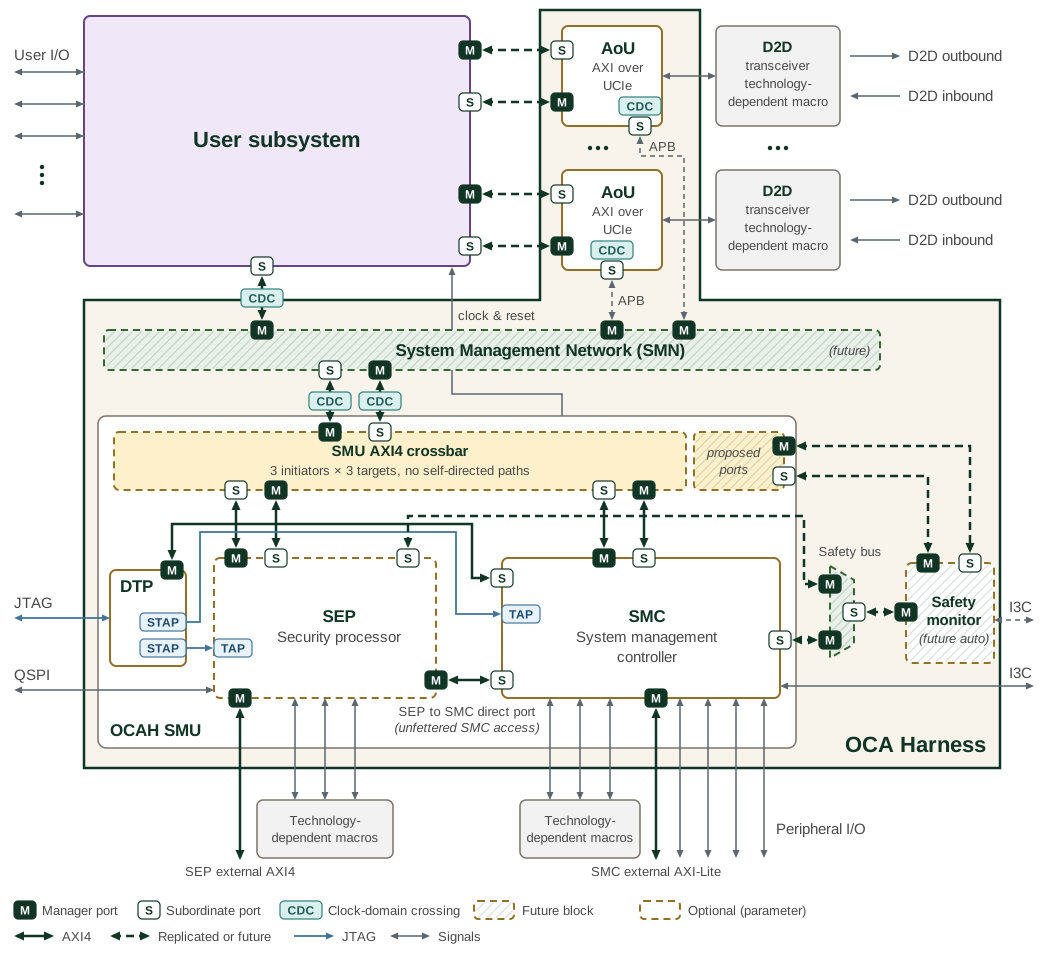
The SMU crossbar permits each initiator to reach the other two targets; self-directed paths are not connected. The detailed connectivity is shown in SMU AXI Crossbar.
Hatched blocks are future: the SMN, the safety bus and the safety monitor. The
crossbar ports that would connect the safety monitor are proposed and are not
part of the implemented crossbar. Dashed outlines without hatching mark the
blocks present only when the SMU CFG.SEP field is 1: the SEP and the SMU
crossbar.