Cryptographic Subsystem
The cryptographic accelerators use separate paths for data and secret keys:
-
The SEP system fabric drives the AXI4 data and CSR bus.
-
Key Manager drives the AXI4-Lite secret-key buses.
The accelerators are derived from OpenTitan, except for the Adams Bridge post-quantum accelerator from Caliptra. The firmware is based on the OpenTitan cryptographic library. Each block’s reference page includes its available register maps; the Detailed Register Map links to those pages.
OCAH adds bus adapters and separate key-delivery paths to the accelerator wrappers. Key Manager writes keys through AXI4-Lite interfaces; the wrappers connect them to the accelerators' key inputs. The following sections describe the shared integration rules and accelerator-specific differences.
Adams Bridge requires 13 SRAM macros with masking enabled (default), or 9 with masking disabled.
Figure 1 shows the accelerator interconnect, Key Manager paths, and external memory interfaces.
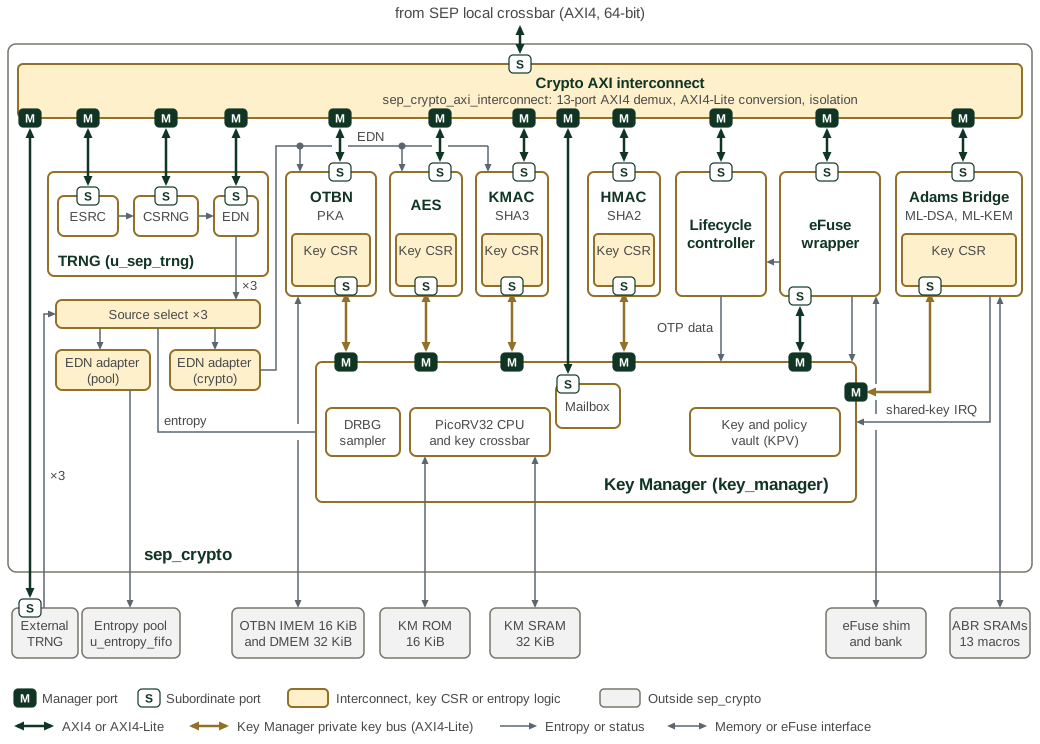
In Figure 1, dark lines are host AXI4 and AXI4-Lite paths from the
crypto AXI interconnect, and brown lines are the Key Manager private key buses.
Each accelerator’s key CSR block is the <accelerator>_wrapper_key_reg block that
receives the KEY_SHARE0, KEY_SHARE1 and KEY_CTRL writes described in
Section 3 and drives the core’s sideload key port. The Key Manager
reaches the key CSR blocks through its internal crossbar; the Adams Bridge key bus
leaves on the right, beside the ML-KEM shared-key interrupt that Adams Bridge
returns. The host paths to the Key Manager mailbox, the external TRNG registers,
the eFuse wrapper and the lifecycle controller are not isolated, and the eFuse and
lifecycle legs leave the interconnect as AXI4. All six Key Manager paths, including
its eFuse access, pass an isolation stage in sep_crypto_axi_interconnect.
The Key Manager also receives OTP data: the eFuse shadow registers supply the
lifecycle state and the identity and class-key fields, and the lifecycle
controller supplies the two demotion states. Grey arrows carry entropy, OTP data
and status one way; the three entropy streams from the DRBG pass through a source
select that can take the external TRNG instead, as the TRNG and DRBG page
describes. Grey boxes are outside sep_crypto: the memory macros live in the
integration layer, and the entropy pool is u_entropy_fifo in sep. The Adams
Bridge SRAMs are 13 macros with masking enabled and 9 without. Interrupts and
OpenTitan alerts are not drawn; Table 1 lists
them.
The integrator must instantiate the Adams Bridge working SRAMs outside SEP and
connect them through the dedicated abr_mem request/response interface.
For the memory interface and configuration requirements, see
SEP Memory Interfaces in the Integrator Guide.
The sep_crypto module implements the integration layer, with
sep_crypto_axi_interconnect centralizing its bus infrastructure. A single
64-bit AXI slave port from the SEP system fabric is decoded to the accelerators
and internal peripherals. The host paths to OTBN, HMAC, AES, KMAC, ESRC, CSRNG,
and EDN are converted to AXI4-Lite before isolation, with data-width conversion
where required by the endpoint. The OpenTitan wrappers then bridge the isolated
AXI4-Lite paths to TL-UL.
The Key Manager drives private AXI4-Lite key buses to the accelerator wrappers, which map key words into the sideload structures expected by the OpenTitan cores. These buses are independently isolated so that they drain before either the Key Manager or the destination accelerator enters software reset.
Each accelerator has its own software-controllable reset. The SEP Reset Controller drains and isolates both its host and Key Manager paths before asserting reset; a Key Manager reset similarly drains all of its key paths. The entropy source, CSRNG, and EDN share one coordinated reset. See SEP Reset Controller and Resetting the TRNG.
Figure 2 shows how the resets from the SEP Reset
Controller reach the instances inside u_sep_crypto.
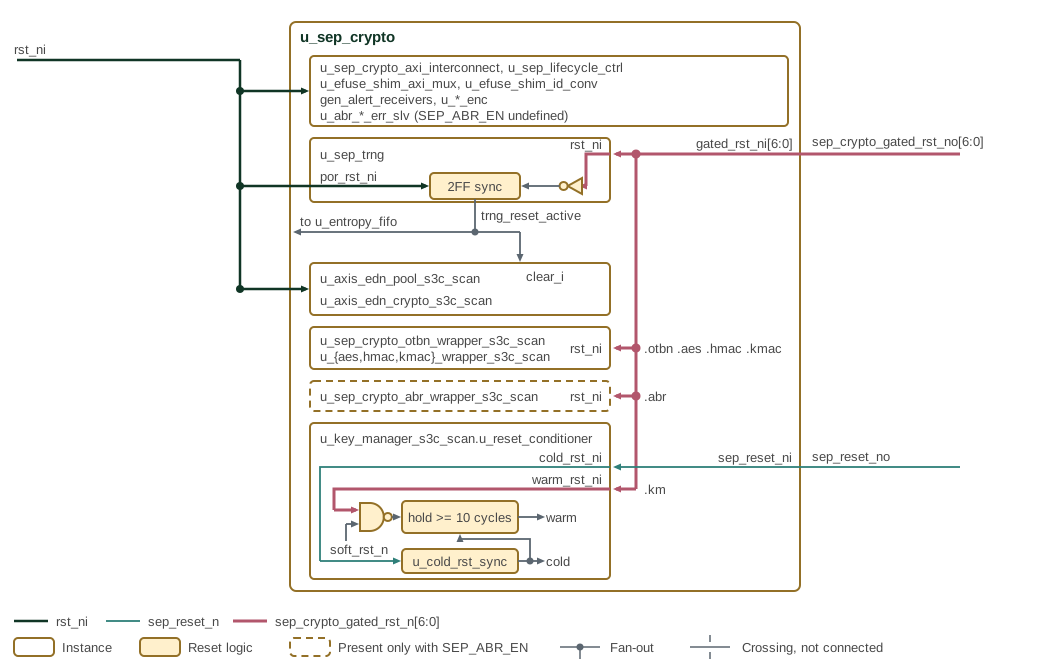
Inside u_sep_trng, por_rst_ni resets a 2-flop synchronizer that samples the
inverted TRNG reset and drives trng_reset_active. That signal synchronously
clears both EDN AXIS adapters and, as trng_entropy_clear_o, the entropy pool.
Both adapters take rst_ni. An OTBN, AES or KMAC software reset cancels that
engine’s endpoints in the crypto adapter (see SEP Reset Controller). The
Key Manager conditions sep_reset_n into its cold domain through
u_cold_rst_sync, and the gated Key Manager reset or its software reset
soft_rst_n into a warm reset held for at least 10 cycles, as
Key Manager cold and warm reset conditioning shows in more detail.
1. OpenTitan Alert Termination
SEP does not instantiate OpenTitan’s alert_handler. Each OpenTitan crypto
alert channel is terminated locally by a prim_alert_receiver in sep_crypto.
That primitive decodes the sender’s differential alert_p/alert_n handshake
and pulses alert_o when the handshake starts; a malformed encoding raises
integ_fail_o. Alert ping is disabled (ping_req_i tied 0); ping_ok_o is
unused.
PIC sources are in SEP CPU Interrupt Vector Map. A receiver’s pulse and integrity-fail stay per-block at the receiver. Table 1 shows which of those, the native error IRQs, and the bridge faults are OR’d onto a PIC source and which are not.
| Block | OT alert channels | Alert PIC | Native error IRQ | Bridge err_o |
|---|---|---|---|---|
HMAC |
|
OR into Crypto alert |
dedicated PIC |
STATUS bit; OR into Peripheral register-bridge fault |
OTBN |
|
OR into Crypto alert |
none |
STATUS bit; OR into Peripheral register-bridge fault |
AES |
|
OR into Crypto alert |
none |
STATUS bit; OR into Peripheral register-bridge fault |
KMAC |
|
OR into Crypto alert |
dedicated PIC |
STATUS bit; OR into Peripheral register-bridge fault |
CSRNG |
|
OR into Crypto alert |
dedicated PIC |
STATUS bit; OR into Peripheral register-bridge fault |
EDN |
|
OR into Crypto alert |
dedicated PIC |
STATUS bit; OR into Peripheral register-bridge fault |
Adams Bridge and the entropy source do not go through this conversion.
The Crypto alert source is the OR of every receiver pulse and integrity-fail, so
that interrupt does not name the block. Native error IRQs are not OR’d. HMAC,
AES, KMAC, OTBN, CSRNG, and EDN convert isolated AXI4-Lite to TL-UL through
axi_lite_to_tlul; each bridge’s sticky err_o is that wrapper’s bus_err_o,
visible as one bit in PERIPH_BUS_ERR_STATUS and cleared with the matching
PERIPH_BUS_ERR_CLEAR bit. The Peripheral register-bridge fault source is the OR
of those bits and the watchdog timer’s bridge fault. Acknowledging one STATUS
bit cannot discard another.
The crypto complex uses whole-instance Class 2 scan boundaries so all
sequential key, round-key, digest-working, seed, and random-distribution state
is covered without per-register marking. The marked roots in sep_crypto are
u_hmac_wrapper_s3c_scan, u_sep_crypto_otbn_wrapper_s3c_scan,
u_aes_wrapper_s3c_scan, u_kmac_wrapper_s3c_scan,
u_sep_crypto_abr_wrapper_s3c_scan, u_entropy_source_s3c_scan,
u_drbg_s3c_scan, u_axis_edn_crypto_s3c_scan, u_axis_edn_pool_s3c_scan, and
u_key_manager_s3c_scan. The integration module itself, public bus
infrastructure, and combinational entropy muxes are not Class 2 roots.
2. Single-Beat Access Only
The sep_crypto demux enforces single-beat access to the crypto region
(Single-Beat Register Access). Any access whose AxLEN is non-zero is
routed to the internal error slave and answered with DECERR on every beat,
whatever its address; no beat reaches an accelerator.
3. Key Manager Key Delivery
The Key Manager delivers keys and seeds to the crypto accelerators over a
private key interface that software cannot read. Every delivery uses the same
format: the value is carried as two shares whose XOR is the value, and each
share is presented as a sequence of 32-bit words in the KEY_SHARE0 and
KEY_SHARE1 registers of the destination. Within a share, word index N carries
value bits [32N+31:32N], so index 0 is the least-significant word and the
highest index is the most-significant.
Both shares are always consumed. Delivering a value V therefore requires two
shares whose XOR is V; writing a single share delivers V only because the
unwritten share reads as zero. KEY_CTRL.KEY_VALID qualifies the delivered
value, and while it is 0 the destination has no valid key or seed.
The words per share, whether software must select the delivered key in preference to the accelerator’s own software key registers, whether software must also declare the key length, and the behavior on an invalid or mismatched key are accelerator-specific. They are stated in the accelerator reference pages and summarized in Table 2; the delivered-key section of the Programmer’s Guide gives the corresponding software configuration.
| Accelerator | Words per share | Select delivered key | Key length | Invalid or mismatched key |
|---|---|---|---|---|
HMAC |
8 (256-bit) |
Not required |
|
Digest is wrong but repeatable; no error |
AES |
8 (256-bit) |
|
|
Delivered key ignored while the select bit is 0; no error |
KMAC |
8 (256-bit) |
|
Applied automatically |
Keyed operation raises an error |
OTBN |
12 (384-bit) |
Not required |
Not applicable |
|
ABR |
8 per block (256-bit) |
Seed read enable |
Not applicable |
Seed read does not complete |
Cryptographic subsystem reference pages: